
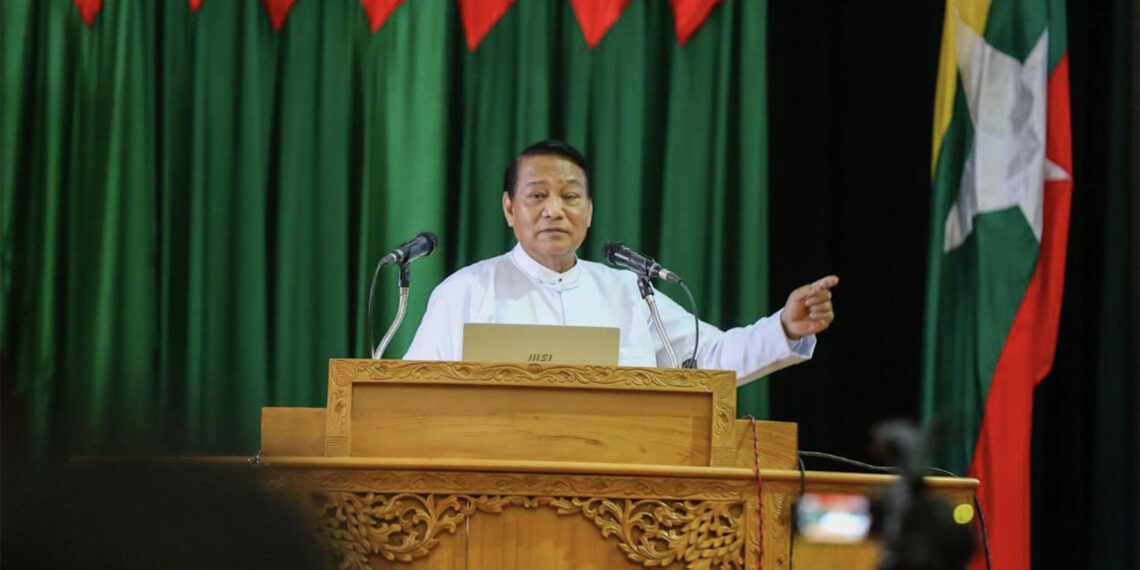
More than 20 senior Myanmar regime figures – including sitting ministers, top generals, and retired officers — will join the military’s proxy Union Solidarity and Development Party (USDP) at junta boss Min Aung Hlaing’s instruction to contest the December elections, according to military sources.
The list includes Transport and Communications Minister Mya Tun Oo, Health Minister Thet Khaing Win, Natural Resources and Environmental Conservation Minister Khin Maung Yi, Energy Minister Ko Ko Lwin, Immigration and Population Minister Myint Kyaing, Labor Minister Aung Kyaw Hoe, Commerce Minister and ex-ambassador to Thailand Chit Swe, Science and Technology Minister Brig-Gen (ret.) Myo Thein Kyaw, and Jeng Phan Naw Taung, who leads two ministries—Hotels and Tourism and Sports and Youth Affairs.
President’s Office Union Ministers Tin Aung San, Maung Maung Tint, and Tun Ohn will also run for office.
Generals joining the USDP include Aung Lin Dwe, chief executive of the National Defense and Security Council Office; Lt-Gen Lin Aung, Military Appointment-General from the Defense Services Academy (DSA) 26th intake; Lt-Gen Teza Kyaw, Bureau of Special Operations No. 6, DSA 28th intake; Lt-Gen Thet Pone; Police Maj-Gen Tin Ko Ko, Deputy Police Chief 1; Police Maj-Gen Aung Naing Thu, Deputy Police Chief 2; Maj-Gen Zaw Naing Oo, Military Engineering Corps, DSA 32nd intake, Lt-Gen Soe Tint Naing; Lt. Gen Tayza Kyaw, Commander of Bureau Special Operation 3; Adjutant General Lt Gen Phone Myat; and Lt-Gen Kan Myint, Chief of Defense Industries.
Military insiders say more senior officers are expected to become election candidates.
USDP chairman Khin Yi said earlier this month that retired military personnel “understand national defense, security, and internal stability”, know “the dynamics of internal insurgency”, and can work with the Tatmadaw (Myanmar military) to maintain order. He described the party as experienced in both governance and opposition, and already contributing significantly to “peace and stability” nationwide.
The USDP — dominated by former generals — suffered heavy defeats to the National League for Democracy (NLD) in the 2015 and 2020 general elections, losing even in its stronghold of Naypyitaw.
The junta’s Union Election Commission has abandoned any attempt to hold voting in vast areas where the regime has lost control. These include 121 constituencies across Kachin, Karenni, Shan, Chin, and Rakhine states, as well as parts of Sagaing, Magwe, and Mandalay regions—areas either engulfed in conflict or controlled by resistance groups and ethnic armed organizations.
Candidate registration closes on September 22. The USDP’s candidate list is once again expected to be dominated by generals.
The USDP won the 2010 election—the first under the military-drafted 2008 Constitution—which was widely dismissed as fraudulent. However, it has lost every national poll since the 2012 by-election. After it suffered another landslide loss in 2020, the party leadership rallied behind then-military chief Min Aung Hlaing to stage the coup.
In 2010, USDP lawmakers joined forces with military appointees—who control 25 percent of parliamentary seats under the constitution—to elect ex-general Thein Sein as president. Junta boss Min Aung Hlaing is expected to follow suit to claim presidential legitimacy after the December-January election.
The article appeared in irrawaddy