
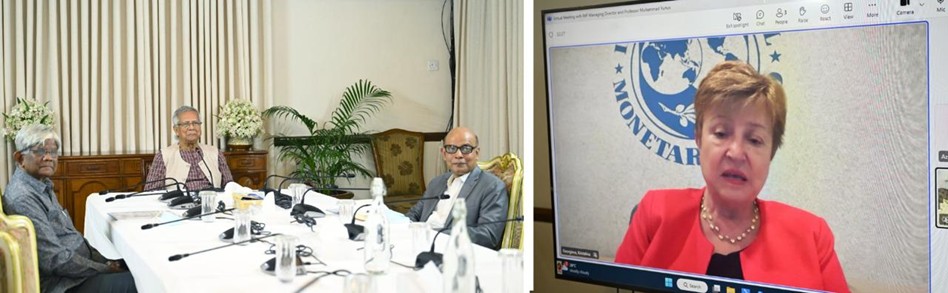
Caption: Nobel Laureate Professor Muhammad Yunus and distinguished guests engage in a high-level virtual dialogue with IMF Managing Director Kristalina Georgieva — a powerful exchange of ideas on global economic resilience, social business, and inclusive growth.
The Impossible Made Possible
“Leadership is not about the next election, it’s about the next generation.” — Simon Sinek.
Bangladesh teetered on the brink. The economy was bleeding by August 2024, foreign reserves had been depleted, banks were rotting due to corruption, and politics became a street battle for survival. The world braced for the worst: another developing nation collapsing under the weight of poor governance.
And then there was an unlikely custodian — a Nobel Peace Prize Laureate, more scholar than politician, who stepped in among the rubble and, much to everyone’s surprise, began stitching the pieces together. Professor Muhammad Yunus, who had been synonymous with organizing people with low incomes through the vehicle of microcredit and campaigning for social business, was thrust into the center of statecraft.
Last week, the International Monetary Fund renewed what Bangladeshis themselves were already coming to realize: Yunus has accomplished the unthinkable. IMF Managing Director Kristalina Georgieva was singing his praises as “the right person at the right time,” thanking him for saving Bangladesh from the precipice of bankruptcy.
The question now hanging over Dhaka — indeed, over the Future of Bangladesh itself — is whether this delicate moment is a brief hiatus, or the foundation on which a new era in the nation’s history will be built.
The Crisis Yunus Inherited
To appreciate Kristalina Georgieva’s lines of appreciation, one would need to recall August 2024, the time Professor Muhammad Yunus assumed office in Bangladesh. The economy was not only weak; it was shattered in multiple directions. What Yunus inherited was not a functioning state but the pieces of one.
The economy was crumbling. Foreign exchange reserves had declined to near a month’s worth of imports, and there was panic in the markets. The taka underwent successive devaluations, fueling inflation and cutting the purchasing power of the poorer people. Prices of staples like rice, lentils, cooking oil, and fuel skyrocketed, immersing millions in hardship. Billion-dollar elites smuggled billions of dollars abroad through unofficial channels, draining national resources further. Domestic and foreign investors lost confidence, halting factory plans and freezing growth.
The banking system was in ruins. Politically influential businesspersons defaulted on massive loans without consequence, bankrupting the banks. Liquidity shortages immobilized, especially the government-owned banks, undermining public trust. Billions were siphoned off overseas through trade-based money laundering. Regulating bodies, weakened by years of political interference, were powerless to instill accountability or order.
Governing had become stinking with corruption. Licenses and government contracts went to ruling party cronies, suffocating merit and efficiency. The Anti-Corruption Commission, the Election Commission, and other key bodies were politicized and converted into instruments of political influence. High-profile corruption scandals in energy, highways, and banks revealed endemic looting of the people’s resources. Even the judiciary and police operated under political pressure, stripping justice of its meaning.
Politics itself was sullied. Opposition leaders were jailed or forced out, reducing the country to a de facto one-party state, if not officially. Reporters, students, and activists were under constant surveillance, harassment, and arrest. Bloody demonstrations and counter-demonstrations paralyzed Dhaka and major cities, strangling commerce. The January 2024 election, boycotted and condemned across the board, erased the last shred of electoral legitimacy.
Expansion turned into maldevelopment. White-elephant megaprojects squandered resources, riddled with corruption and poor planning. Roads, ports, and energy infrastructure remained underinvested and in disrepair—arrogant lending for prestige projects exposed the country to unsustainable debt burdens.
Humanitarian and social domains were also shattered. The Rohingya camps at Cox’s Bazar were confronted with shrinking resources and no repatriation strategy. Hospitals lacked medicine, personnel, and funds, causing patients to go untreated. Universities were arenas of student wings of the ruling party, which were battlegrounds where knowledge was crushed with brutality. Unemployment among youth reached unprecedented heights, leading to frustration and mass exodus.
Foreign policy also fell into line. Dependence on India alienated other neighbors and generated resentment domestically. Its relationship with the West also frayed as democratic erosion and human rights abuses triggered sanctions and censure. Once touted as a rising economy, Bangladesh was again perceived abroad as unstable and unreliable.
In short, Yunus inherited a country whose economy was bleeding, institutions were violated, politics were toxic, and society was on edge. Everyone believed that the shattered system could not be repaired. That is why those words of Georgieva — “You are the right person at the right time” — have so much significance: they not only celebrate what has been achieved, but also how dire the situation really was when Yunus came in.
Building Trust Where There Had Been None
IMF appreciation is not readily earned. For decades, relations between Bangladesh and the Fund had oscillated between cooperation and distrust. Governments, one after the next, selectively used IMF programs, resisting structural adjustments but taking short-term liquidity. Trust was precarious.
Yunus approached the IMF differently. He was not interested in openness and cooperation, a recognition that under a globalized economy, credibility is as valuable as money. His government’s move towards a market-determined exchange rate — something avoided over decades by retribution politicians — restored confidence to markets and institutions.
Reform as Moral Imperative
What is most impressive about Professor Muhammad Yunus’s leadership is not what he has done, but how he has done it. For Yunus, reform is not a technical process of stabilizing the exchange rate and accumulating reserves; it is a moral reckoning with the corruption passed on from an administration that had confused power with plunder.
His statement to IMF Head Kristalina Georgieva was bereft of the customary diplomatic covering: “Some people actually stole cash in sacks from banks and fled the country.” Within that raw description was encapsulated the essence of the Sheikh Hasina era — the era when corruption was no longer covert but overt, when looting of the financial system became a privilege of political patronage, and when the state itself became a private ATM for favorites.
“We took over a devastated and completely shattered economy. Some individuals just stole stacks of cash from banks and fled the country.” — Professor Muhammad Yunus, Chief Adviser
Where Hasina’s administration had thrived on impunity, Yunus calls for answers. Where her administration utilized banks to line cronies’ pockets and strangle honest citizens, his restructuring initiatives aim to bring banking institutions back to their rightful role: serving businesses and citizens, not power oligarchies. Where her taxation system had shielded the wealthy while squeezing out the poor, Yunus’s efforts at digitalization aim to level the playing field and prevent privileged elites from escaping while ordinary families contribute their fees.
Even in such everyday matters as subsidies, the contrast is dramatic. Under Hasina’s administration, subsidies meant sweetheart deals to fuel importers and handouts to politically connected people. Under Yunus’s administration, subsidies are being diverted to people with low incomes, to rural families, to those who cannot absorb the jolts of global inflation. Welfare is being expanded, not eradicated, and small business people are being given some breathing space after years of suffocation by party thugs and bureaucrats.
It is for this reason that Yunus’s approach cannot be classified as technocracy. This is reform with a human face — not austerity masquerading as discipline, but justice manifest in policy. In rescuing discipline for banks, credibility for budgets, and integrity for governance, Yunus is not merely balancing the books. He is reclaiming dignity for a people who had lost both money and trust.
But be assured: this moralist framing is strategic. Reforms cast in terms of moral absolutes are difficult to resist for entrenched elites without the risk of revealing their own corruption. Who is going to argue with the practice of putting pilfered bank money into sacks? Who will have the audacity to assert that subsidies should go to cronies, not poor people? By naming corruption what it truly is — stealing — Yunus handicaps his critics. He leaves them speechless, or worse, having to stand up for the indefensible.
Sheikh Hasina’s heir left behind not just a broken economy but a morally rotten regime, where thievery was the norm and loyalty to the ruling party took precedence over loyalty to the nation. Yunus’s reforms are not technical adjustments alone, then; they are redemptive acts — a reclaiming of honesty as the pillar of governance.
Restoring Credibility Abroad
This ethical plank mattered not only to Bangladeshis at home but also to the international perception of Bangladesh. Foreign lenders, development agencies, and regional groupings had grown weary of dealing with Dhaka under Hasina, in which cronyist patronage, behind-the-scenes deals, and secret contracts were the order of the day. Confidence was lost; Bangladesh was increasingly seen as an irresponsible, not responsible, player.
Yunus’s return disrupted that math overnight. Because his reforms are framed both as economic and ethical, they are a signal to the IMF, the World Bank, the EU, and ASEAN partners that Dhaka is serious, transparent, and credible once more. The transition to a market-based exchange rate, for example, was not merely technical in nature — it was a signal to world markets that the government was no longer going to manipulate the currency to benefit elites artificially. The restructuring of the bank was not simply financial engineering — it was proof that the culture of impunity was being dismantled.
Credibility is money in the bank in international affairs. And Yunus’s moral positioning has earned Bangladesh something money alone cannot buy: the benefit of the doubt. That’s why Georgieva’s encomium was so lavish. She was not simply applauding reforms already implemented, but verifying the credibility of the man in charge, who is driving them forward. For global partners, Yunus represents a rare conjunction — integrity at the top and reform on the ground.
That is also the reason why Yunus’s aspiration to bring Bangladesh closer to ASEAN is considered seriously. The leaders of the region know that a country led by a person who utters the word “theft” is easier to handle than one led by oligarchs who finalize deals in secret. Morality is not only a national defense, but a global passport as well, opening doors long closed.
The IMF’s Strategic Calculus
Georgieva’s respect also reveals the IMF’s grand calculus. In a time when debt distress threatens many developing economies — from Sri Lanka to Zambia — Bangladesh’s recovery under Yunus is a success story the Fund can and will brandish.
Her call for reform in the financial sector and mobilization of local revenue was not rhetorical. Bangladesh’s tax-to-GDP ratio remains among the lowest in Asia, resulting in the state being underfunded. Reform in the financial sector is even more politically contentious as it assaults the very heart of patronage networks.
To be at a place of strength, reform is inescapable. It is such a precious time in Bangladesh’s history.— Kristalina Georgieva, IMF Managing Director
Regional Interests and Global Alignment
Kristalina Georgieva’s exchange with Professor Yunus extended beyond national reforms to encompass broader regional geopolitics. The recovery of Bangladesh, after all, does not happen in a vacuum; its trajectory resonates across an evolving South Asia and an Asia-Pacific region increasingly characterized by competition and realignment.
As they spoke, Nepal was abuzz with a revolution fueled by youth demanding accountability, internet freedoms, and an end to entrenched corruption. Sri Lanka was grinding back from its 2022 economic meltdown, and Pakistan was weighed down with perpetual political instability and a debt crisis. Amid this regional environment of vulnerability, Bangladesh’s steadiness under Yunus was a beacon of exception.
Yunus emphasized in his words that Bangladesh’s resurgence is not in isolation from its role in the larger region. Since India also faces its own economic and political challenges, and China is exerting its power through the Belt and Road Initiative (BRI), Dhaka cannot remain a spectator. Instead, Yunus envisions Bangladesh to be a bridge — geographical, economic, and diplomatic — between South Asia and Southeast Asia.
This vision is already being realized through investment in infrastructure and logistics. The expansion of the ports at Chattogram and Mongla, the development of Payra port, and plans for new container terminals are not only designed to service domestic trade but also to attract regional cargo volumes from Nepal, Bhutan, and northeastern India. Construction of multimodal transport linkages, such as road and rail corridors to Myanmar and beyond, is a declaration that Bangladesh wants to be a gateway, not a cul-de-sac.
Great Power Rivalry in the Bay of Bengal
No explanation of Bangladesh’s regional positioning can ignore the great-power rivalry unfolding along the Bay of Bengal and across the wider Indo-Pacific. Bangladesh spent years stuck in the background — a clothes exporter, a remittance economy, or a South Asian buffer in the region’s turbulent politics. It is now, under Yunus’s caretaker administration, but attempting to position Dhaka as a strategic player at the intersection of Indian, Chinese, and American interests.
The presence of China is growing. Beijing has invested more than $10 billion in Bangladeshi infrastructure under the BRI, including the Padma Bridge rail link, Payra thermal power plant, Karnaphuli tunnel, and different industrial estates. China is now Bangladesh’s biggest trading partner with bilateral trade exceeding $25 billion in 2023, albeit heavily tilted in Beijing’s favor. For China, Bangladesh is not just about economic access, but also about sea access to the Bay of Bengal — a flank of increasing importance in its Indo-Pacific strategy.
India remains a significant partner. The India-Bangladesh trade was $15.9 billion for FY2022–23, and Dhaka was importing raw cotton as well as refined petroleum. India also views Bangladesh as key to its “Act East” policy, providing overland and riverine routes to its northeast landmass. Hasina’s substantial realignment with New Delhi, however, generated unease internally, with critics claiming that India was reaping asymmetric dividends while Dhaka’s sovereignty eroded. Yunus has worked towards rebalancing this relationship — affirming India’s importance, but concurrently making clear that Bangladesh seeks strategic balance, not dependence.
The United States and its allies are closely monitoring the situation. Bangladesh is the third-largest clothing supplier to the American market with over $10 billion worth of exports annually. Washington views Dhaka as a potential partner of the Indo-Pacific Economic Framework (IPEF) and an essential stakeholder in ensuring maritime stability. The Bay of Bengal, indeed, is no mere regional waterway; it’s a vital artery of global trade, carrying nearly one-quarter of world container traffic. The increasing Indo-Pacific presence of the US Navy demonstrates Washington’s interest in having Dhaka as a member of a democratic and rules-based order.
ASEAN offers a new frontier. If Bangladesh manages to become a member, it would be among 650 million people with a combined GDP of nearly $4 trillion. Trade with ASEAN alone is already around $23 billion annually, and becoming a full member would unlock further integration into regional supply chains, the transfer of technology, and investment pipelines. To the ASEAN countries, Bangladesh provides a regional ally on the Bay of Bengal, tying their economies into South Asia while providing balance to Chinese dominance.
This three-way dynamic — between China’s infrastructure push, India’s security worries, and America’s Indo-Pacific vision — creates new bargaining leverage for Bangladesh. An open, reformist, and legitimate government can get more from everyone and avoid being trapped in zero-sum games. Yunus’s approach of framing reforms as moral and open not only reassures citizens but also reassures foreign partners and makes Dhaka a more desirable partner for initiatives such as ASEAN integration or the Indo-Pacific Economic Framework.
But much is at stake. If Bangladesh again goes backward into authoritarianism and corruption following the February election, it will again fall back into being a pawn in the great game rather than a player. And yet, if reforms continue and credibility endures, Bangladesh can become a true bridge nation — one that bridges, and not cleaves, South and Southeast Asia, as it meanwhile stays clear of joining the U.S.-China-India competition with strategic autonomy.
To this end, Yunus’s caretaker leadership is crisis management amplified. It is an opportunity to reposition Bangladesh in the 21st-century global order — not as a passive bystander, but as a proactive stakeholder in the Indo-Pacific region.
Leadership as Transition, Not Possession
The most dramatic point in the conversation was when Yunus reiterated that he would return to his former work after the February election. For those accustomed to “interim” leaders extending their stay too long, this pledge is noteworthy.
“The polls will be held before Ramadan in February. After that, I will return to my previous work.” — Professor Muhammad Yunus.
It is also in the spirit of Yunus’s philosophy: leadership as service, not ownership. He has never sought political power as a goal. His legitimacy derives precisely from the fact that he refuses to be yet another career politician.
A Nation’s Moment of Pride — and Caution
For ordinary Bangladeshis, Kristalina Georgieva’s words resonate as more than a diplomatic form. They are vindication — a reminder that the world today looks at a country once described as a “basket case” emerging as a story of resilience. That term, first uttered by Henry Kissinger in the 1970s, has long tormented the Bangladeshi psyche, a brief for vulnerability and dependency. Today, under Yunus’s leadership, the story is different: Bangladesh is no longer precariously balanced on the brink of disaster, but is gradually stabilizing.
On the ground, there is recovery. Farmers who last year were going through stratospheric prices of fertilizer and diesel fuel now have more stability thanks to subsidies and more regulation of intermediaries. Relief, for a nation where almost 40% of the population is employed in agriculture, has an instant and profound social impact.
Exporters, especially in the ready-made garment sector that accounts for over 80% of Bangladesh’s foreign earnings, are sleeping better these days. The introduction of a market-based exchange rate — initially bitter — has restored predictability, allowing them to price contracts with greater confidence. Western retailers’ orders, previously hamstrung by uncertainty, are gradually gathering pace again.
Households, even with the still-high cost of living, are aware that the gap was averted. Inflation, which surged to over 9% in Sheikh Hasina’s final year in office, has begun to ease, dipping closer to 7% mid-way through 2025. Remittance incomes from overseas Bangladeshis — which were a record-high $24 billion for the previous fiscal year — are acting as a buffer to household budgets, still further evidence of trust renewed in the country’s currency system.
There is a change, too, that is nonmaterial: pride. For years, ordinary Bangladeshis observed their politicians demonized abroad as corrupt, oppressive, and incompetent. Today, they hear the leader of the IMF praising their caretaker prime minister as “the right person at the right time.” In tea stalls, on public buses, in village courtyards, Georgieva’s words are spoken not as a foreign compliment but as a confirmation that Bangladesh can still be admired overseas.
But pride must be tempered by prudence. The rebound is fragile. The majority of the country’s families are but one shock away from destitution, as food prices are still higher than at the crisis peak. Young people’s unemployment hovers at 15%, and graduates vent their frustration at seeing no short-term prospect of decent jobs. Banking reforms, begun though they have been, have yet to grapple with the height of bad loans — still estimated at over Tk 100,000 crore ($9 billion).
And history has chastening reminders. When General Hussain Muhammad Ershad was toppled in 1990, the return of democracy promised neater politics and more equitable government. Within a couple of years, though, old-time rivalries again took their toll, turning Parliament into a theater of boycotts and strikes. Similarly, the 2007–08 caretaker regime heralded a wave of anti-corruption campaigns and technocratic renovation. For a brief moment, Bangladesh seemed poised to redefine its political landscape. But as soon as elections returned, much of the momentum was lost, consumed by partisan revenge and a renewed culture of impunity.
The lesson from the tale is straightforward: moments of pride are no guarantee of advancement. Without vigilance, tomorrow may undo yesterday’s achievement. Yunus’s reforms may have steadied the ship, but it is the political elite that will decide to navigate it forward or crash it on the rocks once more.
This moment, then, is best understood as a respite — a thin window of time when hope has been reawakened but not yet secured. Bangladeshis should be able to take justifiable pride in the fact that the world again respects them due to their resilience. They must, however, also stay alert, for history shows how quickly gains can be erased once politics return to normal.
Conclusion: A Precious Moment, or a Wasted Chance?
“These are such precious moments in Bangladeshi history,” Kristalina Georgieva stated. She was right — but not for the reasons she had intended.
The worth is not only in economic solidity, precious as that is. It is in the awakening of potential that a nation once so deeply under suspicion can regain trustworthiness; that long-held reform may be possible; that leadership needn’t mean domination but stewardship.
The IMF chief’s compliment, thus, is more than diplomatic praise. It is a mirror held up to Bangladesh, reflecting what can be achieved when the country’s leadership is reimagined with integrity.
But experience suggests caution. Bangladesh has been at a crossroads before. After Ershad died in 1990, visions of a new democratic morning were quickly soured into a factional logjam. The caretaker regime of 2007–08 enacted sweeping reforms, only to have its success dissipate once electoral politics defaulted back into established patterns. Again and again, Bangladesh has experienced the promise of change, only to have it dissolve into cynicism and impunity.
February’s survey will let us know if this time is indeed different. If Bangladesh’s political class squanders the reforms and goodwill that Yunus worked so assiduously to get back on track, it will not be another missed opportunity. It will be a betrayal of a generation that once more has dared to dream of a larger Bangladesh.
History will tell if this is a moment of turning point — or only another turn in the cycle of hope and betrayal. The choice does not rest with Professor Yunus, who has done more than his part, but with those who are inheriting the nation he has rescued from the edge.