
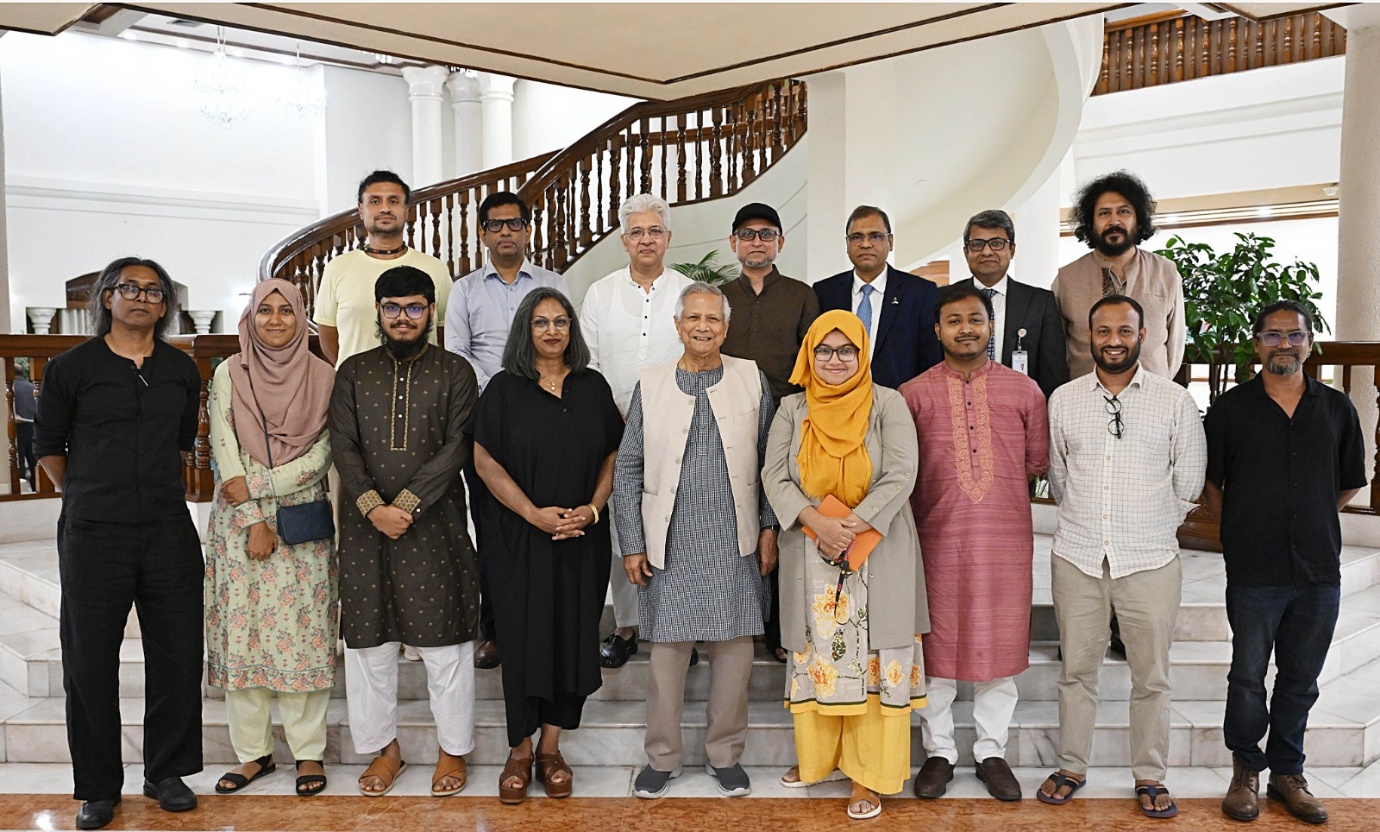
Chief Adviser Professor Muhammad Yunus with members of the July Memorial Museum Committee and cultural leaders at the Jamuna State Guest House, Dhaka—working together to preserve the nation’s collective memory of resistance and resilience.
A Historic Decision at Jamuna State Guest House
Dictatorial regimes may vanish overnight, but the wounds inflicted by them cannot be healed within a lifetime. The history of fascism is not measured in the duration for which it exists, but the depth at which the scars inflicted by it on citizens, institutions, and the nation’s own conscience. Bangladesh has all too painfully experienced such wounds. Sixteen years of Sheikh Hasina’s governance were characterized by patterned repression—from the Pilkhana massacre of army personnel in 2009, to politically motivated disappearances and journalists, to the clandestine torture cells of “Aynaghar,” to the Shapla massacre of demonstrators in 2013, and to the rigged elections of 2014, 2018, and 2024 that reduced democracy to a sham. These were not random excesses, but a calculated part of a strategy to suppress dissent, silence independent voices, and convert the very state into a tool of terror.
In a landmark meeting at the Jamuna State Guest House on 20 September 2025, Chief Adviser Dr. Muhammad Yunus and his staff concluded with momentous national importance: to complete and open the July Memorial Museum by October and November. In his address to the meeting, Dr. Yunus announced, “This museum will not just safeguard the legacy of misrule; it will safeguard the people’s resistance. It is our commitment to the nation that the pain of the past will not be forgotten, and that tyranny will never again have safe refuge in Bangladesh.”
This article talks about how the July Memorial Museum is not just a cultural project; it’s a moral, political, and historical imperative.
Saving the Darkest Chapter
The July Museum will be a firm witness to an era of systemic repression that tormented Bangladesh for sixteen years. It will bear witness to the atrocities that define this season of fascism and give later generations a raw account of how fascism came to hold their own nation.
Within these walls, the visitor will be confronted with the past of the Pilkhana massacre of 2009, when 74 were butchered, and charges of negligence and complicity still hang over the military and the state. Visitors will be confronted with the sickening roll call of forced disappearances and extrajudicial killings, which rendered ordinary citizens specters, silencing voices that once wailed for a cause. The museum will recreate the secret torture chambers of “Aynaghar” (House of Mirrors), where political dissidents and student activists were tortured into submission. It will commemorate the Shapla massacre of 2013, when baton and bullet remorselessly swept the streets of Dhaka, mowing down helpless protesters. And how the manipulated elections of 2014, 2018, and 2024 usurped democracy of its essence, reducing ballots to props in a game of power.
There were no random tragedies or aberrations of an out-of-control state. They were deliberate, calculated part of a system of repression designed to stifle opposition, undermine institutions, and seal one man’s grip on power. The July Memorial Museum, then, is not merely a record of atrocities; it is an exposure of the apparatus of fascism itself.
Chief Curator Tanzim Wahab discussed why this piece matters: “Every artifact we recover—every tattered uniform, every muzzle-covered voice, every document of deceits not history, it is a warning. The July Memorial Museum is built not to live in the past, but to barricade the future.”. By confronting the ugly truth of fascism, we ensure that such evil will never again disguise itself as government in this country. Memory is our shield, and remembrance is the country’s strongest bulwark against the resurgence of tyranny.
By its truthful documentation of such events and by its maintenance as living evidence, the museum will render the truth sacrosanct—no matter how difficult it may be for subsequent political forces to attempt to sugar-coat or distort the record. It will not be just a site of sorrow. It will be a citadel of vigilance, reminding Bangladeshis that freedom can never be taken for granted and democracy must be guarded by memory as its shield.
The Pilkhana Massacre: Betrayal Within the State
The tour of the July Memorial Museum begins with the sad story of the Pilkhana massacre of February 2009, when 74 individuals, including 57 award-winning army officers, were assassinated within the Bangladesh Rifles headquarters. The deaths were termed officially as a mutiny of spontaneous character. But for survivors of victims and relatives of the slain, there are unresolved queries that are the cause of perpetual suspicion, pain, and unresolved sorrows.
Brigadier General (Retd.) Azami, whose friends were among the victims of the carnage, recalls: “The government reaction was slow—intentionally so. Rescue efforts began only after it was too late. Pilkhana was not a barrack; it was the pride of our military heart. Its destruction demoralised an organisation that was meant to defend the nation.”
To widows, widowers, and parents of the slain officers, the massacre was not just a private loss but a state betrayal. They were silenced, forced to swallow their sorrow in the interest of “stability.” One grieving wife put it succinctly: “We were requested to remain silent for the sake of stability. Whose stability? The state’s silence was as hurtful as the killing of my husband.”
A youth who lost his father years before stated many years after: “They said the nation would remember our fathers as heroes. What’s the use of memory if the facts about how they perished are concealed? We sought answers, not clichés.”
Another widow, who had two children in her hand, spoke of her rage: “Year after Year, officials arrived with wreaths and condolences. They never brought the truth. My children should know that their father never came back.”
Even among the military ranks, there is suspicion. One of the retired officers said this: “The massacre was allowed to take its course while the chain of command was paralyzed. It was not an easy mutiny; it was the deliberate shame facing of the armed forces.”
The museum exhibit will envelop the visitor in this new wound of a tragedy. Memorabilia such as blood-stained uniforms, hand-written letters, family snapshots, and war medals will be juxtaposed with government advisories and official reports. The juxtaposition will challenge the visitor to ask herself if truth was traded for political expediency, and if justice was ever even pursued.
The Pilkhana massacre, thus, is more than a horrific exhibition of brutality. Still, a turning point: where the armed forces were undermined, and the people lost trust in them, and authoritarianism started taking root. It is one of the most naked sores on the collective conscience of Bangladesh, and one that is attempted to be kept alive by the July Memorial Museum—not in memory alone, but for accountability.
Enforced Disappearances: A Nation in Limbo
Fewer wounds cut more profoundly than those that never heal. From 2009 to 2024, Bangladesh was tainted by a blood-curdling series of enforced disappearances and extrajudicial killings. Opposition politicians, outspoken journalists, student activists, human rights activists, and even businesspeople suddenly became ethereal nothingness. Disappearance for the regime was turned into a weapon deadlier than death itself, turning absence into an open-ended form of punishment for the victims and their families.
Colonel Hasin, whose cousin was taken away in 2017, summed up the agony in stark words: “A dead body at least gives one the opportunity to grieve. But to live with no idea whether your loved one is dead or alive—that is a savagery beyond comprehension.”
For the families behind, every day was a harsh cycle of hope and disappointment. Mothers left doors unlocked at night, hoping their sons would return home—wives left shirts in closets, never laundered, clutching the scent of a husband who never returned. Children spent childhoods gazing at faded photos, attempting to remember a father’s voice.
One of the mothers remembered vividly as she cried: “He went out with his laptop bag. It was seven years ago. Every time the door knocks, I believe it is him. My neighbors tell me to move on, but how do you bury someone who has not been buried?”
One of the missing lawyers’ daughters had a conversation with the same anguish: “We went to ministry to court to police station. Every door was shut. The silence was worse than the denial—it was as if my father had ceased to exist.”
Hundreds of forced disappearances have been recorded, according to human rights organizations, although the actual figure is estimated to be significantly in excess of this. The majority of victims were later discovered dead in so-called “crossfire” incidents. Others vanished and were never seen or heard from again. Those who spoke up were typically harassed, threatened, or victimized themselves.
The testimonies of the disappearance will be preserved in the July Memorial Museum. Testimony, photographs, and writs of habeas corpus will take their places alongside forensic reports and audio recordings. The displays will prove beyond doubt that disappearances were not random acts by rebel officers but the planned application of a policy of fear—used to silence opposition, frighten society, and secure obedience through terror.
Those who visit the gallery will be forced to endure this limbo: a space where time is suspended, justice is denied, and a nation is forced to dwell in the midst of suspicion.
In honoring the disappearance, the museum brings them back to being. And by documenting their histories, it restores to their families what the state sought to erase: the truth.
Aynaghar: The House of Torture Cell
Perhaps the darkest symbol of Sheikh Hasina’s repressive rule was Aynaghar—”the House of Torture Cell.” Veiled in secrecy, it was a web of secret torture facilities where political opposition leaders, journalists, student activists, and ordinary citizens charged with disloyalty were taken, never to emerge. To mention its name was to foster fear; to venture in was to vanish into oblivion.
The survivors remember a ghastly series: kidnap in unmarked vehicles, blindfolded drive along unknown roads, and detention in soundproofed, windowless cells where even time seemed to break down. Victims lost their identity and humanness and became specters of terror.
One former detainee, now in exile, gave chilling testimony: “Once you were inside Aynaghar, you didn’t exist. They told me, ‘Nobody knows you are here. You are already dead.’ It wasn’t physical torture; it was psychological destruction.”
Testimonies by human rights monitors confirm that the detainees were beaten, given electric shocks, sleep-deprived, and subjected to sensory disorientation. The majority were forced to sign confessions or provide forced statements against opposition leaders. Some of them returned shattered, others never returned. To families, Aynaghar was a word for hopelessness and uncertainty. A wife once remarked, “My husband’s phone ran out at midnight. For months, nothing. When rumors came in that he was in Aynaghar, I prayed not for his release but to know whether he was alive.”
The psychological toll of Aynaghar was as devastating as the physical. Survivors remember hearing other prisoners scream behind walls, never knowing if their time would be next. Others were forced to watch other inmates get tortured in an attempt to break their spirits. One student activist remembered: “They forced me to listen to the tapes of my mother crying over the phone, imploring me to stop politics. That destroyed me more than the beating.”
The July Memorial Museum will bring this horror to brutal life. Soundproofed rooms, half-lit corridors, survivor testimony, and artworks will immerse the visitor in the clammy world of the House of Mirrors. Sensationalism is not on the agenda, but confrontation—confronting the visitor with what occurs when a state turns fear into a political instrument.
Aynaghar is not only an instrument of brutality but also the emblem of what happens when unchecked power denies citizens’ rights, voice, and dignity. It being in the museum is a declaration that no government, present or to come, should ever be allowed to build another house of mirrors in Bangladesh. It is imperative to legally protect and preserve the all Aynaghar, so that future generations may remember them not merely as walls of concrete, but as the very instruments of torture through which Sheikh Hasina sought to rule by fear.
“The law is not only an instrument of punishment, it is also a repository of memory.”. By creating means of preserving Aynaghar as a living memorial, we convert an area of silence and terror into a living witness. The fascist Sheikh Hasina government tried to remove reminders of its own crimes; it is up to us to ensure that no wall, no cell, no scream is ever wiped from memory. In history and law, Aynaghar must be a symbol of injustice so that Bangladesh never allows tyranny of this kind to occur again.” We will pass a law that would protect such Aynaghar with a legal regime.” —- Advocate Tazul Islam, Chief Prosecutor ICT
The Shapla Massacre: Blood in the Streets
Perhaps the most brutal incident of Sheikh Hasina’s time in office was the Shapla Massacre in May 2013. The Dhaka financial district was transformed into a killing field that night. Thousands of protesters, students, teachers, and workers among them—had taken to the streets demanding justice, political reform, and respect for their democratic rights. At midnight, the security forces, heavily armed and battle-hardened from previous clashes, launched a concerted effort to clear the square of the protesters.
The authorities said there were only a few casualties. But witnesses, journalists, and human rights monitors testified to hundreds of bodies dragged away in trucks at dead of night, never to be tabulated by any official record. Independent investigations referred to it as one of the deadliest crackdowns of recent Bangladesh history, a regime-authorized assault on unarmed civilians.
For the families, the evening is an open wound. A cousin of a murdered protester recounted: “My brother went out to protest in just a prayer cap. He came back to us in a coffin.”
A mother who was clutching her son’s blood-soaked shirt told investigators: “He was nineteen. They said he was a threat. What is a boy with nothing but a placard and a voice?”
A father, to whose hospitals and morgues he searched for days, lamented: “They told us they had no bodies. But we saw the trucks driving away from the site, full. My son was on one of them. We never saw him again.”
Survivors describe the mayhem: the bullets, the stifling tear gas, the panic as demonstrators ran into the side streets to be beaten, trampled, or shot. “I ran through the smoke, screams on all sides of me,” one demonstrator, a young man, recalls. “When I looked back, the square was no longer a protest but a cemetery.”
The Shapla hall of the July Memorial Museum will revive such memories. It will juxtapose government denials with the irrefutable reality—pictures, video footage, eyewitness accounts, and testimonies from the families who lost their kin. The viewers will be confronted with the stark reality of a state that aimed its guns not at the foreign aggressors, but at its own harmless citizens.
The purpose of the exhibit is not merely to lament, but to remember that authoritarianism left to itself does not have any qualms about shedding blood to hold on to authority. By keeping Shapla alive in the nation’s memory, the museum guarantees this night of terror is a warning inscribed in history.
Rigged Elections: The Hollowing of Democracy
The final gallery plunges the observers into the era of sham elections that sucked the meaning out of democracy and transformed it into a ritual. Between 2014 and 2024, Bangladesh experienced a cycle of stuffing ballot boxes, voter intimidation, en masse detentions, and wholesale exclusion of opposition parties. There were no democratic elections in the traditional sense of the word, but somewhat scripted plays intended to disguise authoritarian rule under the guise of legitimacy.
The principal opposition party boycotted the 2014 election, and more than half of the parliamentary seats remained uncontested. The public boycotted in protest, and entire constituencies “voted” without a single ballot ever having been sent. The 2018 election was marred by widespread allegations of ballot boxes being stuffed on the evening before polling day, with opposition leaders imprisoned, threatened, or barred from campaigning. By 2024, the pattern was set: repressed opposition, a cowed press, and a population that knew their votes didn’t matter.
Ordinary citizens felt helpless. One young voter in Dhaka recalled: “We stood in line to vote, but when we reached the booth, the boxes were full. That was the day I learned my vote didn’t matter.”
Foreign interference, in this case, by India, was also responsible for the hollowing of democracy. Bangladeshis as a whole remember how New Delhi gave Hasina’s government unqualified support without hesitation for her atrocities in exchange for strategic and economic gains. Regional observers write that the Indian political and security establishment, eager to host a subservient government in Dhaka, continued to legitimize the elections even when international observers declared them rigged. This external legitimacy provided Hasina with the confidence to take power, knowing that she had the cover of diplomatic immunity.
For Bangladeshis, the betrayal was twofold disenfranchised by their own government and abandoned by a neighbor who pursued geopolitical convenience at the expense of democratic principle. A student activist captured: “We were not only disenfranchised by our government. We were betrayed by those abroad who professed to be our friends.”
The Rigged Elections gallery will greet guests with recreated polling stations, counterfeit ballots, stuffed boxes, and the voices of silenced voters. Screens will flash juxtaposed images: officials proclaiming “free and fair elections” as foreign media streamed video of empty voting booths or boxes filled hours before daylight.
By placing these artifacts in the same space, the exhibit will strip away the cloak of legitimacy that covered Hasina’s regime. It will illustrate how democracy was politicized into an illusion of domination, and how domestic authoritarianism and international complicity collaborated to deprive Bangladeshis of their most elementary of rights: the right to choose who ruled over them.
A Deliberate Architecture of Repression
Collectively, the stories recorded in the July Memorial Museum don’t ring like sporadic tragedies or isolated overreaches of power. Instead, they reveal a systematized pattern of repression that is brutally enforced. From the 2009 Pilkhana massacre that shattered the morale of the army to the extrajudicial killings and enforced disappearances that silenced journalists, student leaders, and opposition activists, to create torture chambers like Aynaghar, where sounds of protest were smothered behind closed doors—every move was a part of a grand game of authoritarianism.
The Shapla massacre in 2013 again pointed the finger at the regime’s proclivity to turn the people into enemies of the state by shooting unarmed demonstrators dead in the capital city. And finally, the rigged elections of 2014, 2018, and 2024 drained democratic accountability of all meaning and turned ballots into a mere prop for power while disenfranchising millions.
There were no gaffes of a falling from power administration, but the calculated moves of a regime bent on silencing opposition, dividing institutions, and grabbing totalitarian power. They were part of a script repeated in other authoritarian regimes worldwide: destabilize the military, silence the media, browbeat the populace, and rig the ballot box. Even domestic geopolitics intruded, with India’s tacit support bestowing upon Hasina the cloak of international legitimacy that gave her the confidence to increase repression domestically.
By creating these interconnected chapters with truthfulness, the July Memorial Museum ensures the nation does not forget. It is a counterweight to the distortion of history, a shield against the political desire to whitewash abuses, and a moral compass for generations to come. They will be greeted by the realization that fascism is not made in the moment of violence, but in an architecture thoughtfully designed—one constructed piece by piece, horror by horror, until fear is government and silence is law.
The last function of the museum is to break that silence. By holding on to truth in all its painful complexity, it seeks to immunize the nation against tyranny, to remind every generation that democracy dies not only when bullets rattle, but when memories fade.
Memory as Resistance: An International Tradition
The July Memorial Museum is not unique. Around the world, countries that endured tyranny have built comparable sites of memory.
In Germany, the Holocaust and Dachau challenge the visitor with Hitler’s fascist nightmare of industrialized evil so that “Never Again” is more than an empty phrase. In Cambodia, the Tuol Sleng Genocide Museum documents the atrocities of the Khmer Rouge, turning a house of torture into a house of learning. In South Africa, the Apartheid Museum is a living history of institutionalized racism, so that reconciliation must be grounded in truth, not denial.
All of them have the same mission: to make denial impossible, to pay tribute to the victims, and to remind the living that authoritarianism is always destined to leave violence behind it. The July Memorial Museum places Bangladesh in this international tradition and avers that its struggle against state terrorism is part of a shared human history.
A National Commitment to Truth
Bangladesh came into being in 1971, after a war of liberation covered in blood, against genocide, occupation, and authoritarianism. The identity of the nation has been defined in existence since birth in opposition to tyranny. But lessons have been learnt that authoritarianism can return in alternative forms, veiled in legality and the establishment of powers of the state.
Sheikh Hasina’s sixteen years were particularly ominous, not so much in the duration but in institutionalized and quantifiable repression. Her regime integrated the tactics of fascism with high-tech mechanisms of domination:
- Institutional capture, which amounted to the judiciary, police, and electoral machinery being transformed into instruments of the ruling party.
- Normalized brutality, from extrajudicial disappearances to the establishment of secret torture centers like Aynaghar, where citizens were stripped of their dignity and humanity.
- The hollowing out of democracy, where the 2014, 2018, and 2024 elections were reduced to choreographed events rather than free forums for the will of the people.
- The silencing of the media and civil society, as journalists were arrested, media outlets shut down, and activists forced into exile.
For a nation still rebelling from the July 2024 revolution that toppled Hasina’s three-decade regime by the sheer guts of youths and ordinary citizens, it is timely and of the utmost importance that the July Memorial Museum be established. It is not merely a cultural initiative, it is justice.
The museum is a testament that Bangladesh will not cover its wounds with the soil of silence. It is a statement that memory is not an option but a national necessity if democracy is to endure. Just as the memory of 1971 continues to shape the nation, so too must the memory of these sixteen years be enshrined, so that generations can recall the cost of complacency.
By preserving evidence, testimonies, and remnants of fascism, the July Memorial Museum is a national vow to truth. The museum insists that the crimes of history cannot be erased, rewritten, or forgotten. Instead, they must be confronted head-on, so the citizens of Bangladesh can build a future where votes and not bullets, decide the nation’s fate.
Bangladesh’s July Memorial Museum is a reminder to South Asia
The July Museum is of more than national significance to Bangladesh—it echoes throughout all of South Asia, where state violence and authoritarianism, and democratic backsliding, have left an indelible mark. In institutionalizing memory as evidence, testimony, and public history, the museum is trailblazing in the region: it shows that reconciliation must commence with the voice of truth, and that no regime, regardless of power, is capable of erase its crimes when recorded in the conscience of a nation. For neighbors such as India, Sri Lanka, Pakistan, and Myanmar—nations with records of oppression and violence of their own—the museum is a mirror as much as a lesson. The museum shows that South Asia is not capable of secure cohesiveness and stability through flight from the past, but uniquely so through confrontation with it so that that memory may become a deterrent against the reassertion of tyranny upon the subcontinent.
Conclusion: Ballots, Not Bullets
The July Memorial Museum is a structure beyond stone and steel—it is an ethical pact among Bangladesh’s past, present, and future. Where Holocaust memorials in Europe remind the world that “Never Again” would become a living reality, and while Tuol Sleng in Cambodia or the Apartheid Museum in South Africa remain a constant reminder, this museum will ensure that democracy can never again be left in the hands of fear, silence, or oppression.
By commemorating memory as testimony, evidence, and art, the July Memorial Museum is both a sanctuary of sorrow and a bulwark of defiance. It will provide a voice for the widows of Pilkhana, mothers of the missing, survivors of Aynaghar, and the relatives of Shapla, who had been silenced for too long. It will be a graveyard of fascism and a birthmark of rebirth—a reminder to the nation that the price of freedom is eternal vigilance.
Its message is unmistakable: ballots always lag behind bullets, and liberty will never be defeated by fear. And for generations to come, its walls will echo the same eternal truth—that memory is the people’s greatest weapon, and forgetfulness is tyranny’s most significant victory.