
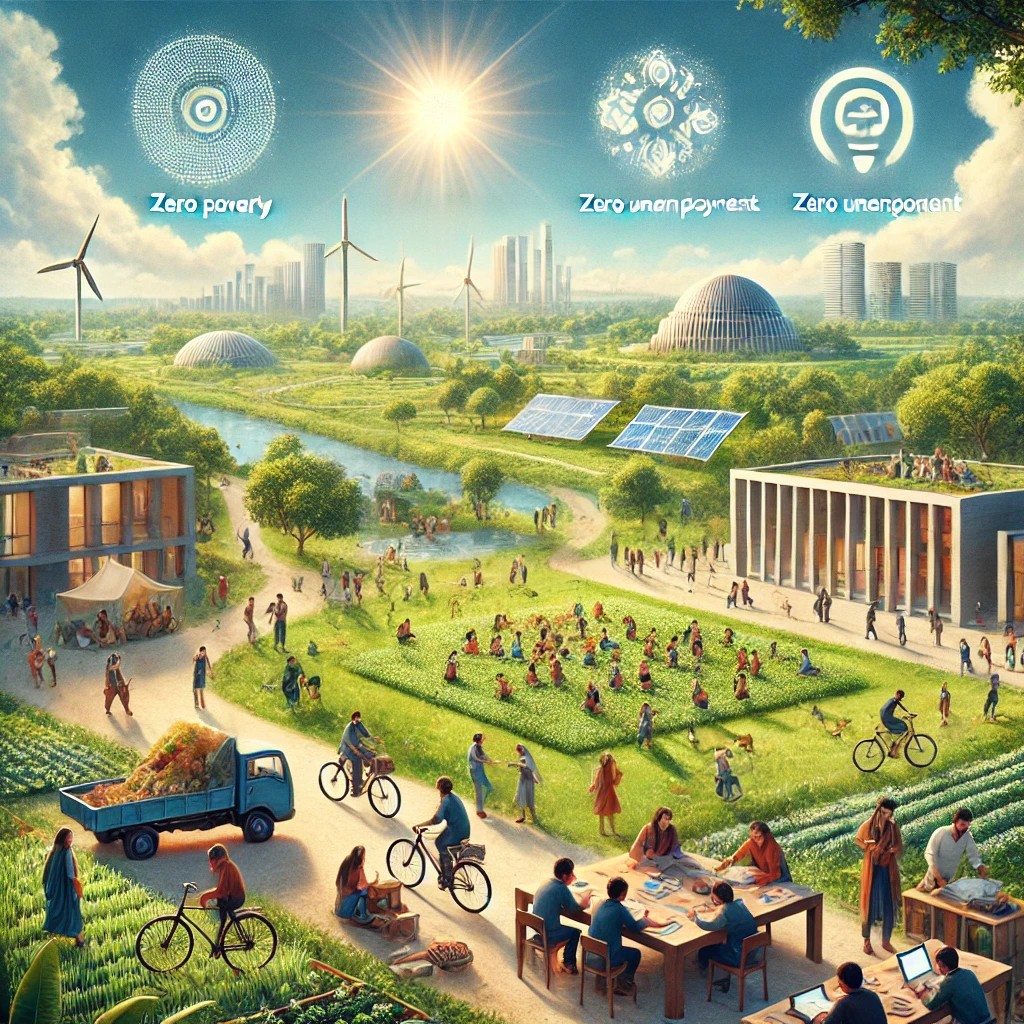
Grameen University: A Beacon of Transformative Education and Social Innovation —Set amidst a vibrant rural landscape, this visionary campus embodies the Three Zeros Principle: Zero Poverty, Zero Unemployment, and Zero Net Carbon Emissions. Diverse students engage in hands-on learning, sustainable entrepreneurship, and real-world problem-solving. The eco-friendly infrastructure—complete with solar panels, bicycles, and green buildings—reflects a deep commitment to environmental responsibility. As knowledge flows beyond the classroom into the community, Grameen University stands as a powerful model of higher education driving inclusive development and lasting social change.
Reclaiming Education for Human Tomorrow: The Vision of Grameen University
“Education is the most powerful weapon which you can use to change the world.” — Nelson Mandela
It’s a world troubled, uneven, youth-unemployment-plagued, institution-weary world—where exhausted models of higher education no longer apply. They were constructed in an era of predictability and entitlement. Our era, however, needs revolution. Universities can no longer be ivory towers. Universities must become engines of empowerment, hubs of knowledge creation, not just for degrees, but for impact. Walk through Grameen University (GU) – the world’s most ambitious and innovative solution to the global education crisis. Conceived by Nobel Peace Prize laureate Professor Muhammad Yunus, Grameen University is not just another school—it’s an education revolution in its nascent stage. It is a paradigm of education founded on social business, sustainability, and inclusive capitalism, embedded in the lexicon of the Global South.
GU is distinctive in not seeking to serve the privileged few. It aims to accelerate transformation for the many, especially those who have been excluded by existing regimes of inequality. It is founded on Professor Yunus’ life’s work: zero poverty, zero unemployment, and zero net carbon emissions. These are not aspirations; instead, they are functional principles embedded in the university’s curriculum, pedagogy, governance, and outreach.
It is not the West’s elite institutions, either. It is special, indigenous, and specifically crafted, considering Bangladesh’s social, economic, and ecological realities, and aspirations to become the shining star of global learning. Its purpose is not merely training the students so that they can manage in the world as it is but motivating the students so that they can transform the world as it ought to be—just, sharing, and sustainable.
It involves personal and professional experience and development, putting Grameen University at the vanguard of socially transformational learning. It is based in its core on a solid foundation of values and an equity-, sustainability-, and social-outcomes-based transformational mission. It transforms higher education with a hands-on and innovative curriculum, centered on a pedagogy that fosters student development of critical thinking, empathy, and agency. Its organizational structure reflects its adherence to distributive governance and civic democracy, and its increasing chain of global alliances enforces its role of bridging ground realities with international best practices. All these, collectively, not only give form to the distinctive identity of Grameen University but also speak of its promise of being a lighthouse institution—charting the future of higher education towards an equitable and humane world.
As Professor Yunus was wanting to say so many times, “We need to redesign universities to become creators of job-givers, not jobseekers.” It’s time we reclaim education back not as a passport to privilege, but a right—and a responsibility—to build a better world.
From Vision to Institution: A New Purpose for Higher Education
“The purpose of education is to teach us to Descartes’ ‘thinks in order.'” — Martin Luther King Jr.
Grameen University represents a paradigm shift in the vision and mission of higher education. While most universities are merely viewed as ladder-like tools of personal social mobility, GU views education as a social and ethical enterprise, where education is closely related to justice, compassion, and empowerment. Dr. Yunus’ “conscience education” is not oratory. It is better than standard grades, careers, or GDP increases as measures of success. Instead, it is about asking questions: Whom does your education serve? What will you fix? GU students in class are not just passive recipients of information but co-participants in seeking solutions back home in their own community.
It has its origins well rooted in Social Business philosophy. At the core of GU, Social Business steers the path of entrepreneurship from returning maximization back to problem-solving. It educates students at GU to create business endeavors that solve human issues—such as affordable healthcare, clean water, renewable energy, and women’s empowerment—but remain commercially sustainable. It is among GU’s most daring inventions, bringing ethical entrepreneurship into the academy.
A Curriculum of Change, Not Just Work
The curriculum of Grameen University is problem-based and multidisciplinary, breaking down disciplinary, sectoral, and classroom barriers. From the very first day, students are exposed to real-life issues through experiential fieldwork, project work, and community interaction.
These courses not only train students in technical expertise but also in systems of ethics, emotional intelligence, and critical thinking. Regardless of what courses their courses are in, whether in climate resilience, in sustainable agriculture, in microenterprise development, or in digital inclusion, students learn issues through multiple ways: economic, social, ecological, and even cultural ways. We’re not here to produce graduates who occupy jobs in the economy today, but we’re here to educate changemakers who will remake and reshape the economy. We challenge students to launch their own social enterprises, to prototype new solutions, and to measure success in impact, not income.
This is made possible by co-creating and mentoring faculty members who are usually hired from practice and academia. Their divergent backgrounds ensure that students are exposed to grassroots knowledge systems and worldwide best practices.
Democratizing Access: Inclusion at the Heart
“The nation’s wealth is in the fruit of the labor of the people and not in idle riches and cached wealth.” — Franklin D. Roosevelt.
The most revolutionary element of Grameen University is its focus on educational equality. While other institutions boast about diversity, GU actively recruits from rural locations, low-income households, and first-generation households, and works to bring those who have been denied opportunities for higher education into positions of power as leaders of society.
Scholarships, sliding-scale fees, rural outreach, and academic preparation support ensure cost or geographic barriers never become intellectual ones. GU doesn’t just open its doors—it restructures the building infrastructure, so underrepresented group students know they’re home.
Along with a demographic response, this inclusion is of a philosophical and pedagogical kind. GU does not think of students as passive consumers of schooling, but students become fellow creators of knowledge. Their own life experiences, child of farmers, of workers in the informal sector, or survivors of poverty—are regarded as enlargements of the curriculum, rather than as places of deficit. It’s this commitment to inclusive excellence that ensures GU is of, by, and for the people and not a university for the privileged few.
Institutional Innovation for a Sustainable Future
“Innovation is what separates a leader from a follower.” — Steve Jobs
Grameen University is also innovative in its organizational structure. Its governance structure strikes a balance between academic freedom and social responsibility, engaging teachers, local community leaders, social entrepreneurs, and development partners in decision-making.
It recommends a networked approach, for which it aligns itself with city governments, global universities, and the Grameen enterprise family. Such connections enable collaborative research, student exchanges, startup incubation, and policy lobbying, and hence the university is transformed into a throbbing hotbed of innovation.
And, most importantly, GU moves the idea of a university from the ivory tower of the metropolitan center into the very heart of the rural community itself. Its sites of learning are not confined to campuses; they extend to villages, on farms, in clinics, schools, and microenterprises. Learning starts in the field, among people, under conditions typical of the problem being tackled.
It is a model best aligned to the United Nations Sustainable Development Goals (SDGs), namely SDG 4 (Quality Education), SDG 8 (Decent Work), and SDG 10 (Reduced Inequalities). Most but a handful of SDG-oriented institutions, however, consent in theory but do not implement on the ground.
Education for People and Planet
“A university should be a place of light, of liberty, and of learning.” — Benjamin Disraeli.
Unlike a world suffering from ecological devastation and unbridled expansion, GU does not keep sustainability in the niche but makes it a regular part of its offerings. Its programs weave in environmental literacy, from sustainable design studios to regenerative agriculture workshops.
Not only are the students instructed to reduce their own personal carbon footprint, but they are also instructed on how to design ecosystem rehabilitation systems. They are trained on how to spark green job-creating businesses, preserve biodiversity, and provide climate justice. With GU’s project, it is acquiring a new generation of students who do not see themselves as proprietors of the earth but instead as custodians of its future.
Of equal importance is GU’s insistence that education must be a civic and ethical endeavor. We don’t just want to produce engineers, economists, or entrepreneurs, but moral human beings, socially conscious, and radically empathetic.
It’s in this light that Grameen University isn’t filling gaps within education; it’s re-mapping what it even means to be educated, period.
Conclusion: Towards a Novel Educational Paradigm
“You cannot hope to build a better world without building better individuals.” — Marie Curie.
Grameen University is no pilot project. It is the culmination of Dr. Muhammad Yunus’ ten years of belief in the dignity of human beings, grassroots sensibility, and systemic transformation. At a time when universities in much of the globe try to mirror the disparities of their own societies, GU embarks on education as a force of freedom, not the transmission of privilege.
They don’t only graduate with a degree; they graduate as change makers, ready to construct equitable economies, resilient rural communities, and a safe planet. They embody the compassion, agility, and imagination that the future requires.
As we face the challenges of the 21st century—pandemics, climate disasters, global migration, the world needs visionary education models like Grameen University more than ever in human history. It is an example of what can be done if, instead of guiding education with market logic, we use moral imagination.
It’s a model of a world after a crisis: founded on humane principles, built around fairness, and molded by the belief that all of us count, and all of us can make a difference.
We can learn from this dream—and, collectively, turn it into a reality, not merely throughout Bangladesh, but in every nook and crevice of our shared world.
I believe that under the guidance of the Trustee Board, and with the incoming Vice Chancellor, Pro Vice Chancellor, registrar, deans, chairs, IT director, Project Director, and every allied department working in harmony, GU will carry Dr. Yunus’ vision forward shaping it into a lasting beacon of hope for generations to come.