
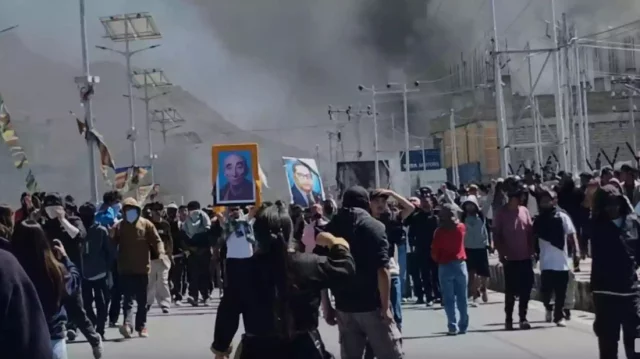
The eruption of violent protests in Ladakh has once again exposed the fragile foundations of India’s control over the territories it illegally occupies. What began as peaceful calls for restoration of statehood and constitutional safeguards has escalated into unprecedented unrest, shattering New Delhi’s narrative of stability in the region. Ladakh, long marginalized in India’s governance framework, has now emerged as a new flashpoint in the continuing crisis of Indian Illegally Occupied Jammu and Kashmir (IIOJK).
From Resentment to Resistance
The anger in Ladakh is neither sudden nor isolated. Since the abrogation of Article 370 and the bifurcation of IIOJK in August 2019, Ladakh was severed from Jammu and Kashmir and downgraded to a Union Territory under direct central rule. This unilateral restructuring, carried out without local consent, stripped the region of democratic protections for land, culture, and resources.
Initially framed by the Modi government as a step toward “development,” the move deepened disenfranchisement. Within months, concerns mounted over unchecked land acquisition, job insecurity, and erosion of cultural identity. By 2020, protests and hunger strikes had become recurring forms of resistance. The present wave of violent demonstrations is therefore not an anomaly but the culmination of years of ignored demands and unfulfilled promises.
The Spark of Violence
In the weeks preceding the unrest, Ladakhi activists intensified demands for constitutional safeguards, with renowned environmentalist Sonam Wangchuk’s hunger strike becoming the movement’s symbol. His call for statehood and inclusion in the Sixth Schedule united Buddhists from Leh and Muslims from Kargil on a joint platform. On September 24, as Wangchuk’s health declined, protests erupted in Leh. Demonstrators hurled stones, torched vehicles, and attacked a BJP office. Indian forces retaliated with batons, tear gas, and live fire, killing at least four and injuring over seventy. Authorities detained more than one hundred people and imposed Section 163 to restrict public gatherings.
This was the first large-scale violent episode in Ladakh since 2019—evidence of New Delhi’s failure to contain dissent through repression alone.
A defining feature of this movement is the unprecedented unity between Leh’s Buddhist-majority population and Kargil’s Muslim-majority community. For decades, India attempted to exploit sectarian differences to fragment Ladakhi society. Yet in this uprising, political, social, and religious groups from both regions have presented a joint platform against the central government.
This alliance has transformed Ladakh’s resistance from local grievance into a broad-based political struggle. The symbolism of Buddhists and Muslims standing together against India’s Hindu nationalist regime undermines New Delhi’s long-practiced policy of divide and rule in IIOJK.
Failed Governance and Repression
The Modi government’s handling of Ladakh reflects securitization and denial, with its high-level committee failing to deliver meaningful progress. Core demands for statehood, job quotas, and constitutional protections have been systematically rejected, deepening local frustration.
This stalemate mirrors India’s broader IIOJK model—where repression substitutes dialogue and militarization replaces governance. Attempts to scapegoat activist Sonam Wangchuk, despite his non-violent appeals, further expose the hollowness of New Delhi’s narrative and legitimacy.
Strategic and Geopolitical Implications
Ladakh’s unrest carries implications beyond its borders. Geographically, it lies at the tri-junction of India, Pakistan, and China, making it one of Asia’s most strategically sensitive regions. It was the site of the deadly Galwan Valley clashes in 2020 between Indian and Chinese troops. Today, while India seeks to project strength abroad, its domestic legitimacy in Ladakh crumbles under the weight of mass protests.
India wants Ladakh to function as a militarized buffer against China and Pakistan, yet its policies alienate the very population it relies on for support. As resentment grows, instability deepens, weakening India’s ability to sustain its strategic posture.
Shattering the Façade of Normalcy
The violence in Leh punctures India’s carefully curated narrative of “normalcy” in IIOJK after 2019. For years, New Delhi presented Ladakh as an example of successful integration into the Indian Union. Yet the eruption of violent protests, hunger strikes, and shutdowns proves that Ladakhi’s no longer accept symbolic committees or empty assurances.
The targeting of BJP offices is particularly telling: it reflects not only anger at the local administration but also a direct rejection of Hindutva’s expansionist project in Ladakh. Instead of assimilation, the Modi government’s centralization has ignited cross-communal solidarity.
Crumbling Control
The violent protests in Ladakh mark more than unrest; they expose the collapse of India’s occupation model in IIOJK. The unity of Leh and Kargil against New Delhi signals growing resistance to central rule. By relying on coercion and ignoring legitimate demands, India has fuelled instability. These protests are not only about statehood but about dignity, self-determination, and rejecting India’s colonial project—revealing its weakening grip in the region.