
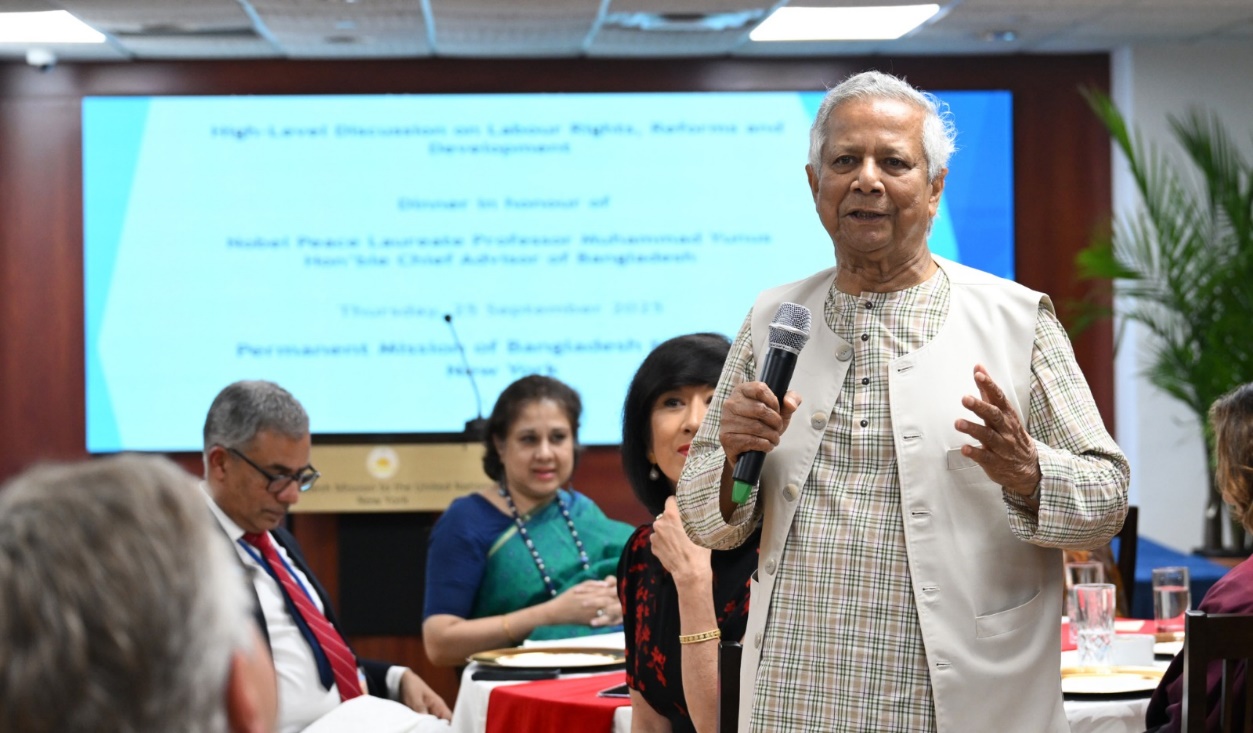
Chief Adviser Professor Muhammad Yunus addresses a high-level dinner discussion on labor rights, reforms, and development at the Bangladesh Permanent Mission to the United Nations in New York, underscoring the urgent need for ethical labor practices as the foundation of Bangladesh’s economic future.
A Dinner of Conscience: Labor Rights as the Key to the Bangladesh Future
In New York’s glassy corridors of the diplomatic world, it was the Bangladesh Permanent Mission to the UN that organized more than just a dinner—what it actually did was spark a national soul-searching and future discourse. Diplomats, senior UN officials, and politicians from both sides of Bangladesh’s split sat down together, united by a single thread: the rights and dignity of workers who turn Bangladesh’s wheels. The agenda of the night went beyond protocol: a glance back and forward, a map, and a past.
The picture of Rana Plaza was seared in most minds in the room. The 2013 factory collapse that killed more than 1,100 garment workers, many of them young women, has been a cause for lamenting the human life price of sacrificing workers’ rights. A tragedy, it was also a wake-up call, exposing an industry’s weakness: having lifted millions out of poverty, it had done so without providing protection. The horror of blood-soaked clothes finding global brands was felt in the consciousness of the nation in Bangladesh, and it reminded policymakers that change is not a concept, but a human messiah.
Chief Adviser Professor Muhammad Yunus dominated the debate, and his message was visionary and timely. He cautioned readers that Bangladesh’s economic miracle—its transformation from a war-devastated nation at the time of the Liberation War to one of the world’s fastest-growing economies—will not last on shaky grounds. Unless and until radical changes are made to protect workers’ rights, enforce labor legislation, and adopt international norms, the country’s economic miracle is likely to come crashing down.
It maintains the gravity and significance of that night’s conversation. It is an examination of why labor reform is more a question of re-engineering Bangladesh’s social contract, restoring dignity to the nation’s working class, and positioning the country for its place in a new, competitive, and values-aware world economy.
Labor Reforms: An Economic Imperative
Professor Yunus continued to opine that Labor reform is no longer an issue of publicity or charity but one of economic imperative. Bangladesh’s readymade garment sector, which generates more than 80% of the nation’s foreign exchange and employs over four million workers, most of whom are women, commands global attention. The European Union preference and the US GSP+ rely on quantifiable increments in working conditions and labor rights, as experienced under the TICFA (Trade and Investment Cooperation Forum Agreement).
Inertia would deny Bangladesh its competitive edge and drive consumers into the arms of its competitors, such as Vietnam, Cambodia, and even some countries in Africa, such as Ethiopia, whose policymakers are going the extra mile in their efforts to entice the world’s brands with low prices and more stringent regimens of compliance. At stake is access to something greater than commerce: Bangladesh’s valuable brand as the world’s second-largest garment exporter.
As appealing as the link with foreign direct investment (FDI) is. Multinationals are increasingly being held accountable to their shareholders and consumers by Environmental, Social, and Governance (ESG) criteria. Investors will not invest in any nation that does not appear to have any rights for the working class. Labor reform, therefore, opens up more than just maintaining garment exports; it also facilitates diversification of Bangladesh’s industrial base into textiles, leather goods, information technology outsourcing, and shipbuilding.
Political Agreement Across the Aisle
The dinner was a rare exception to otherwise politicized Bangladeshi politics: cross-party agreement. The leaders of three major political parties—the Bangladesh Nationalist Party (BNP), Jamaat-e-Islami, and the Nationalist Citizens Party (NCP)—united their voices for labor reform for the first time, citing it as a key to unlocking the country’s prosperity.
BNP Secretary Mirza Fakhrul Islam Alamgir has called the garment sector “the backbone of Bangladesh’s economy.” He reiterated the argument that reform and the survival of the sector are inevitable for any incoming government. Yet, he talked about attempts by the caretaker government to coordinate Labor practices with global commitments. His statements also indicated that opposition parties are ready to undertake the reform program if they come to power.
Syed Abdullah Mohammad Taher, Nayeb-e-Amir of Jamaat-e-Islami, highlighted his party’s interaction at the grassroots level with the garment workers and small factory owners. This interaction provides pragmatic insight to the Jamaat on how change can be brought about in a manner that safeguards workers without compromising the competitiveness of small and medium-sized businesses. His job presupposes a fundamental assumption: reform must prioritize the rights of workers over the tens of thousands of small-scale factories that support the value chain’s viability.
NCP rising star Dr. Tasnim Jara posed the question in terms of people by recalling a memory from the 2013 Rana Plaza tragedy, when, as an undergraduate medical student, she helped care for the survivors. The tragedy, which killed over 1,100 workers, has since sullied the national conscience of Bangladesh and become synonymous with the risks of sloppy Labor regulation. “That instant shaped my politics,” she said to us, reaffirming once again that reform should be based on human dignity and the protection of work. Her statement picked up the torch, reshaping the politics of Bangladesh, its fresh stars basing their legitimacy on reform platforms.
This unusual bipartisan accord was a sign of national awareness: labor reform is not a matter of politics—it is a matter of survival.
The International Context
ILO Director-General and senior UN officials place Bangladesh’s labor transition within the global context. The audience was also reinvigorated by the ILO’s Convention on Freedom of Association, Collective Bargaining, and Occupational Safety and Health, and reaffirmed that its application is obligatory, not voluntary, for countries seeking preferred trading entry.
Bangladesh’s record since Rana Plaza has been uneven. Structural safety has been enhanced through fire safety inspections by the Accord on Fire and Building Safety and the Alliance for Bangladesh Worker Safety. No unionization exists, wages are extremely low, and workers are frequently harassed if attempting to organize.
Labor rights are increasingly aligning with supply chain ethics worldwide. Walmart, Zara, and H&M, the major retailers, are repeatedly pressured by customers and watchdogs alike to source from high-compliance countries. Even ESG investors closely monitor sourcing behavior. For an unreformed country, the likely results are reputational damage, customer loss, and trade penalties—all of which would devastate an export-based economy like this one.
Thus, Bangladesh’s Labor evolution is not just about serving foreign customers, but guiding the country into a new world order where values, sustainability, and human rights are prioritized just as much as price and efficiency.
Implications for Society
Apart from its economic implications, labor reform also has tremendous social implications. The RMG sector has been empowering women in Bangladesh for over five decades, enabling rural women to become independent and transform their domestic lives. Poverty reduction through wage enhancement, employment, and protection would boost such achievement, lifting tens of millions of families out of poverty and ushering in an inclusive society.
Conversely, non-reform will seek to reverse the success. As foreign consumers place cancellations or impose sanctions, women also lose their jobs too suddenly, and they will be pushed further into poverty and reliance on the countryside economy. Disrupting garment earnings could also exacerbate urban migration crises, increase unemployment, and prolong political instability. Reforms, then, are more than international trade—international trade is a question of human dignity, gender equality, and national power.
A Plea for Better Balanced Trade
The highlight of the evening came when opposition party leaders from both sides of the coalition spoke with one voice about how consumers around the world are overpaying. While Bangladesh has long supplied volume-at-a-price manufacturing, incentives disproportionately accrue to retailers. Retailers rake in record profits, while factories operate on paper-thin margins, and workers struggle to break even on their cost of living.
The members demanded fair price regimes that would mirror the actual value of Bangladeshi labor. Others wanted collective bargaining with foreign buyers at the national level, while others proposed leveraging Bangladesh’s reputation as the world’s second-largest garment exporter to negotiate better terms.
This is reflected in a broader appeal to trade justice in the Global South: should developing countries demand not just access to markets, but also equitable terms that enable decent work conditions and fair wages? Bangladesh, by spearheading such changes, is well-positioned to champion the campaign for responsible globalization.
The Road Ahead
In his final speech, Professor Muhammad Yunus reiterated the Interim Government’s commitment to passing substantive labor reform before the February 2026 national elections. He emphasized that Bangladesh’s economic future is not just a matter of words, but a matter of tangible actions with improved conditions for workers and trust with foreign partners.
High on the list of immediate priorities is to improve occupational safety law, Yunus said in a condition of anonymity. While strides have been made since the Rana Plaza disaster in 2013, loopholes remain regarding structural safety, fire safety, and protection against disease that put the lives of millions of workers at risk. The Interim Government is attempting to implement even more stringent checks, more severe punishments for offences, and increased accountability measures for factory owners. This, Yunus pointed out, is not only essential to prevent another national outcry but also to keep overseas buyers’ and regulators’ patronage.
Equally important is the guarantee of the right to bargain collectively and organize without fear of intimidation or reprisals. Freedom of association has been a contentious topic within the labor climate of Bangladesh for a long time, hindering workers’ access to a voice that can demand better remuneration and working conditions. Adopting labor laws in accordance with ILO conventions gives workers a rightful voice, while also promoting healthier and cleaner employer-employee relations.
Yunus also called for the minimum wage system to be overhauled immediately, as it has decreased as a share of inflation and the cost of living. For women workers in the garment sector, wages are merely sufficient to avoid debt poverty traps but are still at a subsistence level. At the same time, their households remain vulnerable to debt-poverty traps. A re-adjustment of the minimum wage to the living wage rate would not merely put millions of workers above the poverty line; it would also help remedy the issue of low-income earners just scraping by. However, it would also spur domestic consumption with multiplier effects on the rest of the economy.
Finally, the Chief Adviser also urged extending labor protection coverage to the garment sector. Other sectors, such as the leather, shipbuilding, and IT outsourcing, are also emerging and can diversify Bangladesh’s export basket. Coverage of fair working conditions and rights in these emerging sectors will safeguard workers against exploitative labor practices, make Bangladesh more resilient to sector-specific shocks, and enhance its reputation as an ethical, growth-driven country.
If these reforms take hold, Yunus concluded, Bangladesh would not only be able to preserve its comparative position in the international economy but also become an exemplar of moral success. It would be a beacon of a developing nation achieving balanced economic growth with human dignity, demonstrating that economic progress and social justice are not mutually antagonistic but complementary to each other.
Conclusion: Toward a New Social Contract
The Bangladesh Mission dinner was more than a diplomatic courtesy: it was a sign of a new social compact. It was an implicit recognition that the previous paradigm—the one with low wages, few protections, and reliance on foreign purchasers—is no longer tenable.
The future prosperity of Bangladesh will not be quantified in terms of export or GDP growth, but by the ethics it applies to its workers. If it happens, then Bangladesh might be first to spearhead the move from “workshop of the world” to world leader in ethical trade, a shining light to developing nations across the globe caught between economic ambition and human rights.