
By Kamila Fayzieva
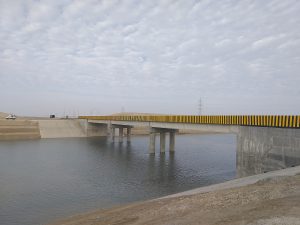
As climate change accelerates and water resources in Central Asia continue to shrink, the construction of the massive Qosh Tepa Canal in northern Afghanistan is raising alarm among neighboring states. Designed to irrigate more than 500,000 hectares of arid land by diverting 20-30 percent of the Amu Darya’s flow — a lifeline for millions in the region — the project carries profound ecological, economic, and political implications.
The project is a particular hope for the people of northern Afghanistan, where, according to eyewitnesses, there is very high drug addiction among young women who work long hours carpet weaving. Some reportedly give opium to their babies to keep them sedated so they can work. There are few other options for families to generate revenue.
For Afghan farmers, long battered by drought, poverty, and subsistence labor, the canal is a symbol of hope. Yet for Uzbekistan, Turkmenistan, and Tajikistan, it risks exacerbating an already critical water deficit driven both by natural factors and rising temperatures.
Today, experts warn that losing a significant share of the Amu Darya’s flow could undermine agriculture, energy, and ecosystems in Central Asia — while the absence of international water governance leaves the region exposed to additional challenges.
Ecological and Climate Fallout
Climate and water expert Bulat Yesekin called the canal a “historic mistake.” He argued that the ecological costs will be severe: accelerated desertification, land degradation, and worsening climate instability. The Amu Darya already no longer reaches the Aral Sea, a stark reminder of past mismanagement.
“Biological processes that maintain the region’s balance are already disrupted,” Yesekin warned. “Further reduction of Amu Darya flow will worsen the climate, endanger floodplain forests and meadows, and deepen the ecological crisis.”
Yesekin drew global parallels: the U.S. and Europe are dismantling dams to restore rivers, while Central Asia continues to expand irrigated land. He called instead for “restoration of natural processes” and regional cooperation with Afghanistan through a “water-food-energy” exchange mechanism.
Hydrological Risks
Hydrologist Denis Sorokin estimated that the canal could divert between 8 and 20 percent of the Amu Darya’s annual flow, depending on climatic conditions and efficiency losses. In dry years, downstream states could lose up to half their irrigation quotas.
“The greatest economic losses for irrigated agriculture will occur in dry years,” Sorokin explained. “Uzbekistan and Turkmenistan face reduced crop yields, soil salinization, and renewed ecological crisis in the delta and the Aral Sea.”
Sorokin stressed that Afghanistan has alternatives: restoring traditional karez systems, adopting drip irrigation, and engaging in transboundary cooperation backed by international support. Without Kabul’s inclusion in regional frameworks, he warned, the risks of crisis are unavoidable.
Ecological Fragility
Ecologist Pavel Volkov underscored the fragility of the Amu Darya ecosystem: “The construction of the Qosh Tepa Canal will seriously affect all local ecosystems along the river. Species of flora and fauna will vanish, biodiversity will shrink, and desertification will intensify. New small deserts will emerge, soil erosion will accelerate, and dust storms will grow more frequent.”
Volkov emphasized that nature’s interconnections mean cascading effects. In a region already highly vulnerable to climate change, any additional disruption could trigger far-reaching consequences.
Economic Vulnerabilities
Economist Abdulla Abdukadyrov pointed out that the issue is not absolute water scarcity but irrational use. He argued that optimizing existing agricultural practices is far more efficient than expanding irrigated areas at the expense of shared water resources.
“It must be the target orientation of the entire economy, especially agriculture,” he insisted. “If we do not do this voluntarily, nature will do it for us — with a major catastrophe for the region.”
Abdukadyrov warned of food deficits, worsening poverty, and the potential for destabilization by external actors exploiting crises.
Farmers on the Frontline
The risks Abdukadyrov described are already visible in Uzbekistan’s fields. Chronic water shortages plague Bukhara, Kashkadarya, Khorezm, and Syrdarya provinces. Farmers report that irrigation water arrives only once every 5-10 days, while drip irrigation often proves too costly or ineffective.
An anonymous survey of 18 farmers across 12 provinces conducted by the author revealed that most had experienced water disruptions in recent years, and many said they cannot afford modern irrigation technologies. A majority stressed that without subsidies for inputs and water, agriculture will stagnate; all agreed that without adequate water supplies, crops will fail.