
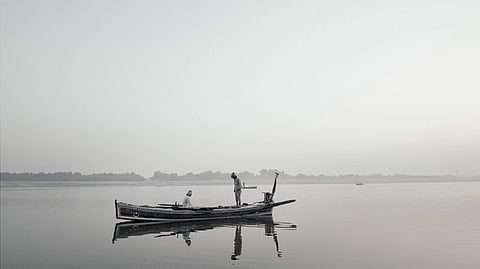
From 11 September, the day before the Pakistan release of Indus Echoes, I was impatiently checking for when it would finally come to Karachi. My impatience washed away as I finally sat down for a screening on 19 September. The film, after all, is a test in patience. It demands that the viewer look and speculate; it also assumes they will be able to follow along without the need for exposition.
(My gripe with much of Pakistani commercial cinema is that it often does the opposite. Directors feed the viewer fast-paced, excessively dramatic dialogue paired with simmering background music that leaves no room for ambiguity within the plot.)
Indus Echoes is special for several reasons. It is the first Sindhi-language film to be released in Pakistani cinemas in 28 years, making it the first of its kind for Sindhi youth of my generation. It is also a unique co-production between creatives based in Pakistan, Bangladesh, South Korea and Ecuador. Yet, despite this being a landmark production, reception was muted in Karachi. I counted just eight people in the roughly 150-seat hall when the movie began on its opening night in the city. By the end, the number went up to only around 25.
Since 1979, all films scheduled for public screenings in Pakistan must abide by regulations imposed by the relevant censorship authorities, as noted in the Motion Pictures Ordinance. In Indus Echoes, censorship efforts could only be discerned in the omission of profanities. The Karachi screening included English subtitles – a necessity since only just over 11 percent of the city declared itself as Sindhi-speaking in Pakistan’s 2023 census.

In Pakistan, the domestic film industry overwhelmingly favours Urdu- and Punjabi-language productions, in genres such as romance, comedy, action thrillers, and – as of last year – horror. Since the 1990s, there has also been a considerable effort by the media and the public-relations wing of Pakistan’s armed forces, Inter-Services Public Relations (ISPR), to produce films, documentaries and dramas that highlight patriotic service. Even beyond ISPR-funded productions, there has been a visible increase in patriotic war movies. The vast majority of these are entirely in Urdu, with a sprinkling of English for dramatic effect.
INDUS ECHOES is not a commercial film, nor does it market itself as one, so it is understandable that it forgoes the usual gimmicks in favour of greyscale colouring and a three-person cast.
Samina Seher, Vajdaan Shah and Ansaar Mahar deliver stellar performances befitting their experience in theatre. All three are aided by a fourth cast member, of a kind: the Indus River, ever-present in sound even when not in sight. Clever costume choices and hairstyling allow the three cast members to embody five roles in total, although credit must also be accorded to their collective experience, with each actor enabling coherent transitions between roles through shifts in posture and linguistic register.
The past 30 years have seen a sharp decrease in Sindhi movie production as investors have increasingly shifted their focus to television dramas and the occasional music album instead of cinema. Following the 1956 hit Umar Marvi – named after the 14th-century Sindhi folktale about a village girl kidnapped by a local ruler – romance emerged as the dominant genre in the 1970s, with films such as Baadal Aain Barsat (Clouds and Rain) and Ghoonghat Lah Kunwar (Take Off the Bridal Veil) remembered particularly for their soundtracks. Nowadays, one finds the occasional telefilm such as Sher e Sindh (Lion of Sindh), in which rural towns are portrayed as lawless lands in need of a strongman to uphold justice against all odds.
The relative stagnation of funding for artistic ventures today parallels the precarious economic situation of the characters in Indus Echoes, all of whom propose or reject suggestions of leaving. The Indus can barely sustain the people living on its banks, yet if one were to up and leave, where could they go? What exists in the world beyond the Indus River?
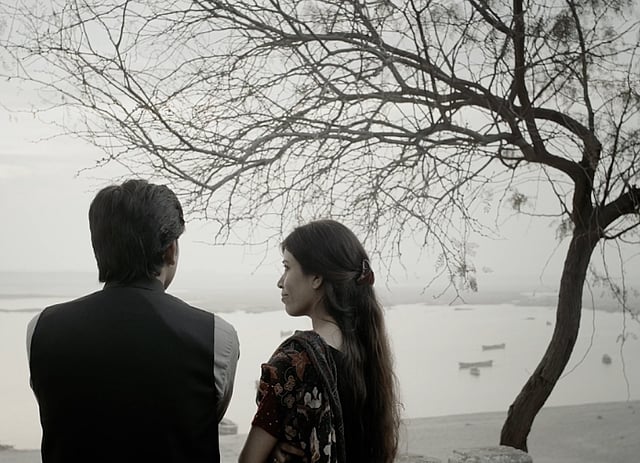
These questions come up over the span of the movie’s five vignettes, loosely connected by the colourless water of the Indus and a premeditated murder. Through the perpetrator, the victim, a witness and their loved ones, we hear and see the precarity of life by the river. Some scoff at the idea of leaving: an elderly woman we meet only as a caricature performed by her son, a brother who sees no other path, and a daughter left with a field that yields unreliable harvests. Looming above all these characters is the river – alive but diseased.
This river did not become diseased on its own. Indus Echoes points no fingers at the usual culprits responsible for the state of Sindh today. If it did choose to, there would not be enough hands to point to every landlord, politician, religious cleric, petty industrialist and gang leader who has stolen from this land.

The film makes its impression not by preaching but by showing; the river and its dependents’ daily murmurings are enough for anyone from Sindh to know who brought devastation to this land and who is left to pick up the pieces. We are shown furrowed brows, people staggering, hands clutching a makeshift idol – and the river, always the river.
Ripples of sunlight dance on the still water, stalks of wheat sway in the breeze, beauty marks dot a character’s face. One can imagine this land and its river to have been beautiful once, perhaps before they were routinely subjected to the persistent cycles of drought and flooding that feed contemporary economic and social decay. Sindh is particularly vulnerable to flooding and its fallouts, due both to its geographical location and socio-economic conditions; in 2022, the province received 400 percent more rainfall than its 30-year average.
Alongside climate change, the province has long been subject to an outdated Labour Code that endangers industrial workers, leaving them to toil in precarious situations, often under exploitative contract systems, without being able to unionise or earn livable wages, according to the National Trade Union Federation General Secretary Nasir Mansoor. A similar situation affects fishing communities and agrarian communities, which are disproportionately impacted by seasonal irregularities yet remain sidelined in political processes overwhelmingly dominated by the landowning class.
ANY SEMBLANCE of nostalgia a resident of Sindh might hold for a once-beautiful past is shattered as the film progresses. As a historian, I am especially wary of narratives that feed into an idealisation of the past, when people were happier and systems functioned. The people of Sindh do not have the luxury of idealising their feudal past, nor their contemporary feudal realities, where academics, students and others routinely go missing or are hunted down. Consider the abduction and detention of the student activists Ghani Aman Chandio and Sarmad Mirani; the killings of Shahnawaz Kunbhar, accused of posting blasphemous content online, of the educationist Ajmal Sawand, caught up in a tribal feud after an honour killing, and of the blogger Nazim Jokhio, whose body was found at the home of a lawmaker from the Pakistan People’s Party. All of these remain fresh in Sindh’s collective memory. A verse from the poet Salman Jakhro’s ‘Nim Ji Chaon’ (The Shade of the Neem Tree), which punctuates the gaps between each of the vignettes, captures this notion succinctly:
رت جي راند ھر دور ۾ آ رچي
۽ لٽيرن ھتي، حق جي ھاڪ ھنئين
ڀل مياڻي ھجي، يا تہ مڪلي ھجي
خون ۾ لال ٿي آھي ڌرتي سڄي
The game of blood has been played in each era
Due rights have been looted
Be it Miani or Makli [marking the northern and southern limits of the Sindhi-speaking territory]
The entire land is stained red with blood
There is no effort made to point fingers at any culprit – any landowner or politician – for Sindh’s slow degradation. No one person can bear the blame for repeated systemic failings made possible through consistent looting. If the ordinary residents of Sindh cannot feed themselves today, it is because of a decay that stretches back centuries, and which has become entrenched so deeply that its residents can only ponder leaving.
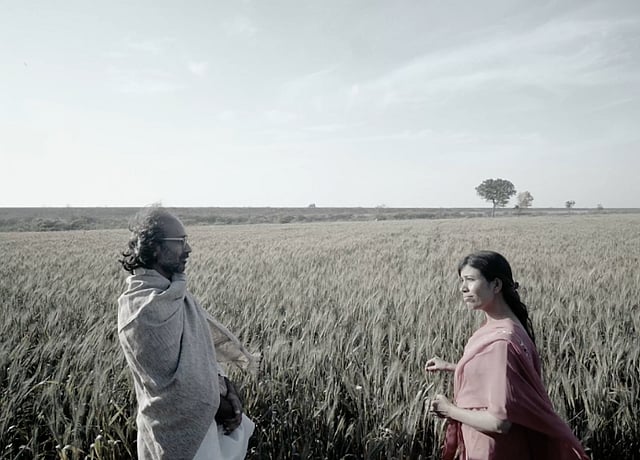
Though all five of the film’s characters entertain the notion of leaving, only one packs their bags and sets off for an undisclosed town. The future for those who remain is certain, for it is much like the past. The greyscale colour palette serves its purpose amid these developments; the decision to leave is neither right nor wrong.
Despite the weight of Sindh’s stagnation and the Indus River’s diseased portrayal, I would be hard pressed to describe this film as tragic. The strength of the disjointed vignettes lies in their portrayal of everyday life. Death walks hand in hand with all the characters. One remarks that life can only be recognised after a brush with death. Another says that hope is found at the bottom of the river, when all are finally laid to rest with the fishes. Before the credits roll, we are left with a final question: “Will you listen to the story?”
INDUS ECHOES travelled the world before coming to the residents of Sindh. The film premiered at the Jaipur International Film Festival, was also screened in London and is set to be screened in Canada. The stories it contains have already transcended geography, much like the Indus River itself, which begins in the highlands of Tibet, passes through Ladakh, Gilgit–Baltistan, Khyber Pakhtunkhwah and Punjab before finally entering Sindh and flowing into the Arabian Sea. More than 15 major and minor tributaries feed the singular flow of the Indus by the time it enters Sindh, rendering it the lifeline of the province. The stories of the film’s characters echo the centrality of the Indus in the life of this place. The river gave them life, and one day it will claim their bodies.
In that brief time between life and death, one character says, all we can really desire is a mouthful of food and water. It is this simple desire for a reliable form of sustenance that marks the state of Sindh today. In a land where there isn’t enough to go around, families and friendships fall apart. The debate surrounding migration is incessant. And yet, it is a path that not many can opt for.
I wonder if for others with roots in Sindh – especially those who live beyond the reach of the Indus – this film was able to pull at something. In the days leading up to the screening, and even afterwards, I ended up talking to many relatives about topics I don’t usually bring up. After all, each one of us is busy scurrying around different corners of Karachi, trying not to lose our minds in traffic jams and in the employment rat race. The film filled the space that art often does; it gave us something to connect over beyond the shared fatigue of simply surviving.
As the end credits rolled, I walked out of the exit in front of a group of teenagers who dismissed the film in a mix of Urdu and English as “too pretentious, with predictable shots.” In the cinema lobby, two young boys took turns taking pictures of themselves posing beside the film’s poster. As I left, the remnants of Indus Echoes’ silence was drowned out by the blaring horns of Karachi’s Rashid Minhas Road. I spent the taxi ride home trying to remember the last time I had seen the Indus River.
The article was published in the himalmag