
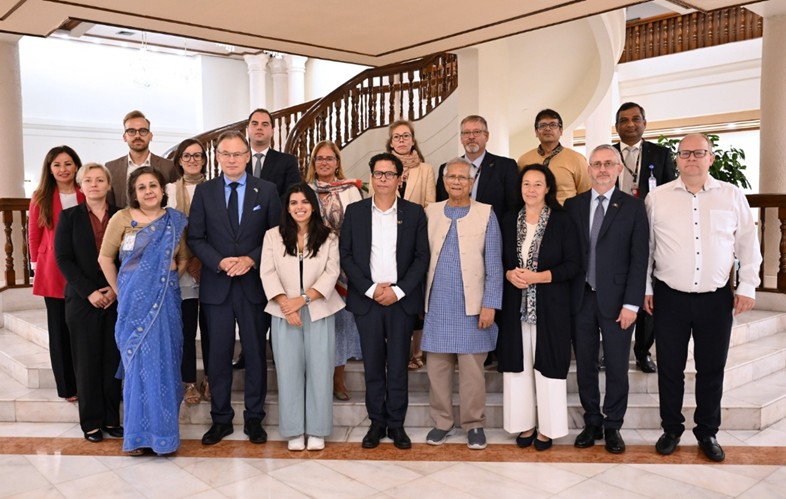
Chief Adviser Professor Muhammad Yunus with Members of the European Parliament delegation led by Mounir Satouri, following their dialogue at the State Guest House Jamuna in Dhaka on September 17, 2025—reaffirming Bangladesh’s commitment to free, fair, and festive elections in February 2026.
Historical Promise
Bangladeshi elections have rarely been a cause for celebration. Far too many times, they’ve been tainted by intimidation, fire, and bloodshed—violence that creates fear of the democratic system rather than hope. Against that grim backdrop, the statements released September 17 at the State Guest House Jamuna took on special significance. Chief Adviser Professor Muhammad Yunus, addressing visiting Members of the European Parliament headed by Mounir Satouri, promised that next year’s scheduled general election in February 2026 would be “peaceful, clean, transparent, and festive.”
It was no sudden affirmation. It was a risky wager to redefine the politics of elections in a country starved for democratic resurgence after decades of authoritarian inclinations and rigged elections. In the past two months, inklings of that exuberance already materialized. For the first time in over three decades, college campuses witnessed students queuing up for polling centers, deliberating over candidates in corners, and waving enthusiastically as votes were counted—a return of bottom-up democracy that holds out the promise of how “celebratory” a national election is going to be.
To all those February first-time voters by the millions, Yunus’s promise is a promise as much as it is a challenge. The purpose of this piece is to examine what that promise is, how daunting those obstacles in its way are, and how it could be revolutionary if it is maintained.
The Shadow of Past Elections
Bangladesh’s electoral record is tainted by mistrust and fraud. The BNP boycotted the 2014 election; as a result, over half of the seats in parliament went uncontested. The 2018 election, although labeled participatory, was tainted by accusations of ballot stuffing and intimidation, and poll watchers widely condemned it.
Elections had come to represent desperation rather than empowerment for younger Bangladeshis. That past hangs over 2026. The removal of Sheikh Hasina’s government in 2024, overthrown by revolutions of the youth and foreign pressure, opened up space for rebirth.
The choice of Nobel laureate Muhammad Yunus without political liabilities was unexpected but deliberate. It took someone of world standing and moral credentials to guide the nation through a volatile transition.
Survival to Reform
Short-term survival needs gobbled up the first few months of the Interim Government. Having come to office in August 2024, Bangladesh’s economy was teetering on the edge of disaster. Foreign exchange reserves had hit the lowest level in over ten years, and balance-of-payments disaster fears had started to mount. Inflation was raging, devouring the purchasing power of ordinary citizens, as unemployment rates among younger generations spiraled out of control in the very constituency of society that had descended into the streets demanding change. Corruption scandals, ingrained in nearly all sectors, had weakened state institutions. In panic mode to prevent total financial disaster, the government was forced into hasty fixes with the International Monetary Fund (IMF), the World Bank, and major bilateral partners. Sales of stabilization packages, brokering fresh disbursements, and rebuilding donor confidence were the overriding government’s agenda.
However, Yunus was not satisfied with his government’s identity being that of an emergency response. Attentive to the fact that stability without change would only postpone bigger disasters, he pushed for a more aggressive program to mend credibility, at home and abroad. Labor reform was a large front. Bangladesh’s readymade garment (RMG) sector—the economy’s backbone and catalyst of over 80 percent of its exports—had depended heavily on privileged access to European markets. Succumbing to Brussels’s pressure, tied to better labor conduct and workplace conditions, Yunus’s government implemented sweeping reforms of the country’s labor codes. These included better wage settlements, better union authorities, and better workplace inspection in factories so that the garment sector would be in a position to sustain its competitive edge in the global market while conveying that workers’ dignity would be protected.
Another was openness. Government projects for decades had been hit by corruption and mega-sized contracts. The caretaker government implemented computerized procurement procedures and external audit mechanisms to dismantle old patronage networks. In higher education, it was also marred by politicization and poor governance; reforms were implemented to institutionalize accountability within university administration. These reforms were not just technical changes—these were to replenish citizens’ trust in institutions that citizens had grown to distrust.
Most politically sensitive of all was the effort to depoliticize the bureaucracy. Government institutions, from police to civil administration, under preceding regimes were commonly seen as tools of ruling parties, whose task was to safeguard partisan interests, rather than those of the people. Yunus’s government began to rotate top officials out, to restrict party influence over appointment and promotion, and to take up codes of conduct that encouraged neutrality. Though that process was by no means complete, even token steps issued a vital signal: the state was of the people, rather than of a specific political party.
Most conspicuous and representative of reforms, however, was the restoration of student body elections to open campuses. Some campuses had been without student body elections for over three decades, robbing generations of youths of one of their first tastes of democracy. By restoring the contests, the Interim Government attempted to reinstitute grassroots-level democracy at the very seat of the civic process. Students again queued up outside ballot boxes, debated manifestos, and cast votes—many for the first time in their lives. The symbolism of young Bangladeshis regaining the franchise to choose their Campus Representatives mattered much. It was a more-than-ordinary activity in the field of university administration; it was something of a harbinger of the coming generational reset, set to find its fullest expression in the General Elections of February 2026. Collectively, they constituted a transition from survival to tentative rebuilding of institutional and democratic norms. For Yunus, securing the current was only half the task: he wanted to signal that Bangladesh could escape from its habit of drift to statist policies and emerge the stronger for it.
Europe’s Deep Stake
The MEPs’ visit emphasized Europe’s connected economic and political interests in Bangladesh. The EU is Bangladesh’s largest buyer of apparel at over €22 billion annually. Access to trade depends upon the state of government and labor quality, so reforms are mandatory.
At the same time, Europe is among the biggest donors to the Rohingya catastrophe, whose cuts in aid shut down the refugees’ children’s schools. Yunus called for additional funding, concerned that an “era of lost generation” was stoking extremism and unrest.
One of the Dutch MEPs commented that Bangladesh could be one of the only countries of the Global South wherein “things are going in the right direction.”
It is pragmatic and principled for Brussels to support Bangladesh’s transition to democracy—securing trade, stability, and geopolitical leverage in the Bay of Bengal.
“Festive” Democracy
Why is it festive for an election? For Chief Adviser Muhammad Yunus, language is not coincidental nor every day. It attempts to redefine the mode through which Bangladeshis think of political participation. Elections in the country for years had come to be associated not with festivity, but with terror: street battles, burning, rigging, and mass deployment of security troops. Every round of elections only unraveled wounds did not close them—immersing the people into terror, not into hope. In dubbing the February 2026 elections festive, Yunus envisions ending that tradition at its core. He pictures the election as not a battlefield of terror, but a people’s carnival of choice—a day when old and younger citizens come together to enjoy the exercise of voting as a civic carnival.
But celebrations, as even Yunus would admit, cannot be built out of declarations. It must be founded upon stringent institutional guarantees that will give citizens confidence that they will be safe and that their celebrations will not be misused. It is upon this that the first of the pillars is built, that of an unbiased Election Commission. So far, Bangladesh’s Election Commission has been seriously accused of partiality and of yielding to pressures by ruling parties. It has promised to be returned to autonomy in composition and practice by the Interim Government, so that it can be a referee and not a player in the game. It is only on trust that, however many banners or balloons, an election can be transformed into a celebrative event.
No less crucial is the integrity of the voter rolls. Prior elections were sullied by phantom votes, double registration, and even blatant roll tampering to benefit incumbents. Voter-roll transparency, certified by electronic verification and third-party audits, is paramount. For new citizens, the millions of them who will be voting in 2026—their right to see their names included is part of the party itself, an assurance that they count.
Press freedom is the third requirement. An electoral celebration requires the press to move as they please, to write with impunity, and to hold government and parties accountable. Bangladesh’s media have existed for too long under the fear of censorship acts and intimidation. The protection of journalists, provision of diverse voices, and restraint from suppressing critics will be crucial to making February a celebration rather than a mere charade.
And then, of course, there is the issue of law and order. In previous elections, the police and security forces have been routinely accused of acting in favor of the ruling party, crushing opposition processions while disregarding the transgressions of the ruling party. Yunus’s carnival dream of democracy needs that exact opposite: police that guard, rather than menace; police that guarantee poll goers enroute to the polling booth, rather than hold them back. The imposition of a fair order is not merely about controlling violence; it is about ensuring the atmosphere of joy and security that is the subtext of celebratory metaphors.
Unless those assurances are there, the promise of the festive election can reduce to form minus substance parade in finery that lacks trust. The Interim Government’s task is therefore twofold: to maintain the semblance of festivity that appeals to popular imagination, and to introduce the substance of fairness that conveys popular trust. If either of them delivers, February 2026 can be not merely an election, but indeed a national celebration of rekindled democracy.
The Youth Factor
Since nearly half of Bangladesh’s citizenry is below 25 years of age, Bangladesh’s future is bright in the responsible hands of Bangladesh’s youth. Such is the demographic reality, and it is not just numbers; it is political power that has already begun to alter the nation’s course. It was the youth and the students, supported by smartphones and motivated by indignation, that congested the roads during the July 2024 revolution. It was they who, through their perseverance, courage, and unwillingness to tolerate authoritarianism, dethroned Sheikh Hasina’s established regime. In many respects, even the Interim Government itself is the byproduct of youth politics, that declaration that the next generation is not only the voters of tomorrow to cast ballots, but actually the contributors to political change here and now.
Millions of first-time voters will be going to the polls in February 2026. It will be the first time for them to experience the authentic flavor of being part of a real democratic exercise free from ballot-stuffing and violence that marked elections in the past. The symbolism is vast: a generation that was capable of bringing about regime change through street agitations may now stand to gain from legitimizing that change through ballot-hunting.
These Bangladeshi youths are digitally informed and internet-enabled, living in a global village where news and information cross borders in seconds. These young people are keenly aware of the way in which their counterparts in Sri Lanka, Nepal, and other parts of the world have utilized collective power to combat corruption and poor governance. Facebook, X, TikTok, and YouTube have become not only sites of entertainment but of learning and politicization. The July 2024 uprising was planned to a great extent over platforms of end-to-end encryption, by live protests, and by social media campaigns. It has created a generation that is impatient with politics, not willing to wait for decades to witness incremental change, and demanding that leaders respond in real-time.
Their requirements are distinct from those of the old political elite. Their requirements are for work commensurate with their capabilities in an economy under increasing danger from automation and international transformations in the fashion sector. Their requirements are for climate protection in a country that is in the world’s top ten countries at risk from sea level change, cyclones, and floods. Their requirements are for respect in government, leadership that is untainted from corruption and patronage, and actual change in healthcare and education. Digital rights, free speech, and women’s empowerment were issues that they could resonate with, testifying to their universal exposure to universal values and norms.
If they welcome this generation—if parties of every hue are forthright about their agendas and their rhetoric—they can inundate old vote banks for patronage-based, kinship-based, and identity-politics votes. They can force political campaigns to discuss policy issues such as the quality of education, green energy, innovative technologies, and mass growth. Youth engagement can transform the very nature of Bangladeshi politics from a personality cult to a policy dialogue.
But risks are proportionate in depth. If the February vote does not materialize—if it is marred by fraud, exclusion, or violence—youth disillusion can be more profound. That same generation that toppled an authoritarian state might once again surge into the streets, albeit more enraged and less institutionally entrenched this time. Youth who feel alienated from society are again vulnerable to exploitation by fanatical dogma and transnational currents of grievance. Stakes are therefore massive: trust or betrayal, embracing or rejection, elation or disintegration.
Youth Factor is not a diversion from the election of February 2026—it is its essence. Whatever Bangladesh does to its national youth will determine not only the fate of one poll but the fate of its future for centuries to come.
Rohingya Crisis: An Implicit Variable
Hanging over Bangladesh’s emerging democracy is a humanitarian catastrophe that sometimes resurfaces for brief mention. But it never hits the headlines and quietly influences the nation’s political future: the plight of over a million Rohingya refugees barricaded at Cox’s Bazar. Bangladesh has shouldered the world’s most enormous refugee load since 2017, when Myanmar’s military unleashed waves of mass killings and forced evacuations. What began as a relief operation for a disaster has grown into an extended catastrophe from which neither party can see escape. For nigh on seven years, the world has sent periodic, albeit meagre, relief to the bases of the Rohingya settlements. But exhaustion has set in. Relief flows of funds have declined markedly since 2023, with the United Nations and relief bodies having to cut food rations, halt health programs, and, most importantly, close the schools of refugees’ children. The results are devastating. An entire generation of Rohingya kids now risks growing up unread, with little hope of securing even decent work, and no hope of return to Myanmar at any moment of the foreseeable future. It is not just that this is an opportunity cost of such human proportions—it is a breeding ground for exploitation, terrorism, and crime.
Plea by Yunus of Harvard to the European Parliament delegation to give more funds has to be considered in that context. His appeal was not an instance of humanitarianism at all but of political realism. An uncontained Rohingya crisis is directly jeopardizing Bangladesh’s stability. Tension between the refugees and Cox’s Bazar’s host population is already mounting due to competition over scarce resources, environmental destruction, and mounting insecurity. Reports of drug trafficking, human trafficking, and militias settling into the camps have also instilled fear of abandonment.
No democracy will be able to endure for more than a few years under such stress. It is apparent to the Interim Government that domestic political legitimacy is not only the result of having successfully organized a clean poll, but also of securing stability in those areas under stress from humanitarian pressure. Stability in Cox’s Bazar is the same as stability in Dhaka. If trouble from the camps—whether by violence, extremism, or overwhelming displacement—is transplanted directly to domestic politics, it will immediately cleave society and destabilize government.
Further, the question of the Rohingyas is deeply enmeshed with Bangladesh’s external policy. The inability of the world community, particularly ASEAN and the United Nations, to secure their safe return to Myanmar has left Dhaka to its own devices for the job. In Yunus’s view, it serves as a nudge to spur Europe to play a larger role, which is also a matter of strategic imperative. Without additional international intervention, Bangladesh risks becoming a reluctant haven for a permanent refugee population, and all the economic, social, and policy implications that follow. Here, the question of the Rohingyas is Bangladesh’s silent variable in the transition to democracy. An election in February is likely to resuscitate the dream of democracy. However, unless the question of the refugees is settled with all dispatch and international intervention, the stability of the state will be at peril. Yunus is warning severely: democracy cannot take root if a million human beings are suspended mid-air over it. It is not just a question of humanitarian necessity that they be treated—it is at the core of Bangladesh’s future and security.
Risks and Opportunities
Bangladesh’s path to its elections in February 2026 is dangerous and unusual in its promise. The balance that the Interim Government manages to that point will be the variable that sees the country’s democratic reset either a breakthrough moment or a lost chance.
Risks can’t be overestimated. Worst of all are the spoilers of the old regime that hold assets and networks at their disposal. Most of these players, fearing they might be summoned to answer for corruption or politicization of power, must see the election delayed or discredited. Others will seek to mobilize loyalist elements of the bureaucracy, judiciary, or security establishment to cause instability. Still others will attempt to make use of propaganda campaigns, using social networking sites to disseminate seeds of doubt over the purity of the polls. To what degree the Interim Government will be resilient is, of course, dependent upon its own capabilities to predict and preempt these designs without becoming quite so heavy-handed.
Also of concern are world market-induced economic shocks. Bangladesh’s remittance- and export-based garment economy is yet vulnerable to shifts in world demand, unstable oil prices, and supply shocks. Further slowdown of Western economies or yet another world food and energy price increase may erode popular patience, making populations more inclined to be rallied by populists. Inflation is already taking a strain, and even slight shocks can risk fomenting instability in the period leading up to the election.
Third is the potential for violence that can endanger credibility. Bangladeshi elections have always been preceded by street fights, coerced entry into homes, and even casualties. Use of muscle power by politicians or interested parties to bully votes or scuttle meetings can replace Chief Adviser Yunus’s fantasy of a “festivity” with fear in minutes. It will be easy for outside observers to highlight such disruptions, calling into question the validity of the proceedings and undermining the very credibility that the Interim Government is trying to maintain.
But even as they are valid risks, the promise is so vast. An open and transparent election offers the possibility of rebuilding trust in institutions that have come to be perceived as corrupt. If the Election Commission is fair, if votes can be cast safely by citizens, then February 2026 can be the beginning of the tradition of demokratiya founded not upon distrust but trust.
Youth involvement is of paramount significance. If the number of first-time voters is in millions, Bangladesh has the potential to inject fresh blood into its politics. If they choose to dictate the national agenda through their issues—job, knowledge, climate change, corruption—the country could emerge from the ages-old rut of party politics that has enveloped politics for decades. Youth dynamism can change Bangladesh from personality-oriented to issue-oriented politics, shaking up the electoral landscape for at least a generation.
The opportunities don’t stop at the nation. International certification of the validity of the election would have numerous returns. Successful elections would support Bangladesh’s claim for further tranches from the IMF and World Bank projects, increase foreign investor confidence, and strengthen its reputation as a reliable economic partner. It would also support the influence of Dhaka diplomatically in seeking to become an ASEAN member, thus putting the country itself into one of the world’s fastest-growing regional organizations. That status would also secure additional support in addressing several of the region’s common challenges, such as the Rohingya issue, climate finance, and regional security.
In South Asia, where democratic backsliding is the new normal—Myanmar has its junta, India is sliding into authoritarianism—such a real Bangladeshi election would be a rare exception. It would demonstrate that it is possible to reboot, that a wounded country so bedeviled by the specter of authoritarian drift can change its ways, and that citizens—in short, the youth—can reclaim democracy not through blood in the streets, but through ballots in their own hands.
Future Directions: Bangladesh 2030—Two Future Scenarios
The 2026 election is not just the ascent of the new government to power—it is a turning point that can define Bangladesh’s fate for the rest of the decade. Two diametrically opposite futures are possible in 2030, depending on whether the nation rises to the challenge or crumbles under pressure.
The better of the two futures is that of Bangladesh capitalizing on the potential for rebirth. An unfettered, equitable, and celebrative election puts people’s faith back in democracies. Youth representation recasts the policy agenda, compelling parties to campaign on grounded issues such as job generation, renewable energy, IT innovation, and climate durability. Global recognition unlocks new aid from the IMF and the World Bank, as well as private capital, giving the economy a boost. Towards the end of the decade, Bangladesh is not only a middle-income state but also a democracy exception in an otherwise region of authoritarian retreat. Membership of ASEAN also brings the nation all the more into the global value chains, complementing its role as the bridge between South Asia and Southeast Asia. Above all, politics becomes more about accountability than personality cults—about delivering policy, not promises—clearing the way for sustainable stability.
Worst-case, however, danger overwhelms opportunity. Spoilers successfully undermine elections, by delay, by violence, or by manipulation. Optimistic youthful voters at first become disillusioned, lose interest in politics, or return to street protests. Economic shocks—whether from world recession, climatic disasters, or declining garment exports—erode public patience. International monitors raise their seals of approval, stall releases of IMF funds, and dissuade investors. Bangladesh in 2030 may be another case study of democratic backsliding, enmeshed in instability and incapable of reaching its economic or social potential.
The path that either of these two futures takes will be shaped by actions in the coming months: whether the Interim Government can make the polls free and fair, whether the political parties will accept the process, and whether the international partners are prepared to underwrite Bangladesh’s transition. The stakes could not be higher. February 2026 is not just one election—it is the question of how Bangladesh wants to be by 2030.
Conclusion: Ballots, Not Blood
In the most significant test in February, there will be no sloganizing and ceremony needed, but whether ballots or blood will determine the fate of Bangladesh. The world will watch, but its people will primarily be the judges of whether disillusion or renaissance. If Dr. Yunus’s promise is realized, the poll will not merely choose leaders—it’ll revive hope and prove that Bangladesh’s democrats can once again be celebrants.
February is the month during which Bangladesh can translate even its wounds into hope festivals.