
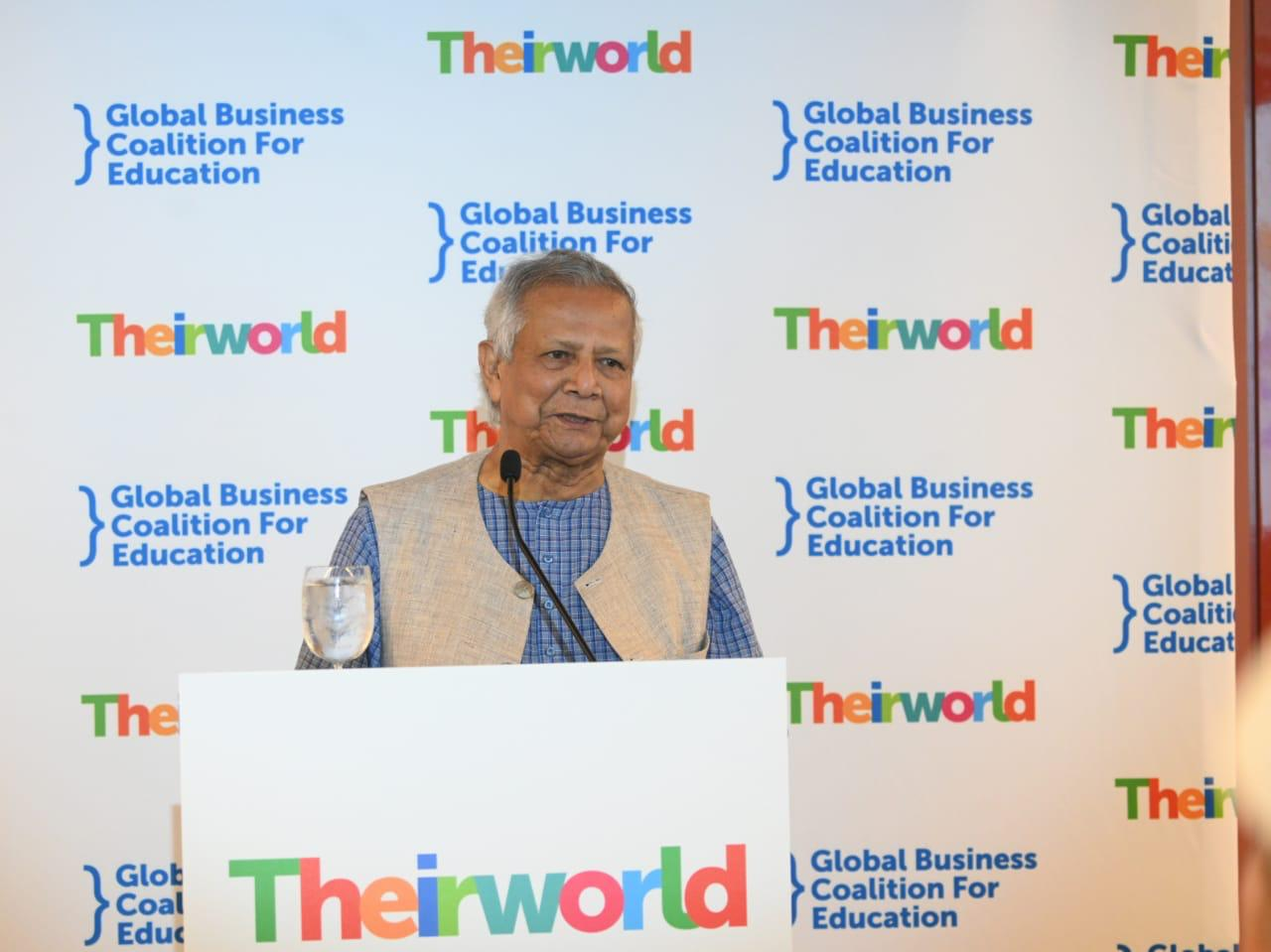
Nobel Laureate Professor Muhammad Yunus speaks at the Global Business Coalition for Education event hosted by Theirworld, highlighting the transformative power of social business and youth-led innovation in building a more equitable, sustainable future.
At the United Nations Headquarters in New York this week, Nobel Peace Prize Laureate Professor Muhammad Yunus rose to address in a voice carrying the urgency of crisis and the promise of renewal. Within a room often hijacked by speeches, his words were distinct—urgent, but motivational; sobering, yet visionary. Addressing a high-level side event on Social Business, Youth, and Technology, Yunus reminded the world of a truism he has been advocating for decades: business cannot continue to be a force that is constantly centered on profit. It needs to be about serving humanity. It needs to heal the planet. It must maintain the dignity of every human being.
This was not a discourse of abstraction. This was a cry for survival. Humanity today stands at a perilous crossroads, where choices made now will determine the destiny of unborn generations. Climate disasters blaze with merciless ferocity, poverty bites deeper, wars erupt across the world, and technology casts a shadow over us, promising to liberate us or bind us in fresh shackles. Yunus here challenged us to rethink economics itself—not as an instrument of exploitation, but as a force of inclusion, sustainability, and shared prosperity. Essential to this vision is the revolutionary concept of social business.
The Global Crossroads
Let us start by recognizing the world we inhabit. The weave of our existence is unravelling under colossal strain. Blazes in half the world incinerate crops and woodlands, and in the other, drought devastates. Conflicts render millions homeless, disrupt economies, and threaten world food supplies. The seas rise and inundate nations that contributed least to causing global warming but stand to lose the most—like Bangladesh, Yunus’s native country.
Old answers—such as incremental reform, development assistance, or blind hope that growth will trickle down—are sinking. What Yunus did was to point out that we can no longer be repairing new crises with old tools. Instead, what we need is bold systems change.
And at the heart of that change is a belief that business must be reimagined—not as an extraction way of extracting wealth, but as a way of mending things.
Why Social Business Matters Now
Social business has a straightforward and revolutionary premise: companies can be established to solve problems rather than to maximize profits.
This is no dream. Yunus’ own life attests to its feasibility. What began as a small, one-dollar loan to a Bangladeshi village woman developed into the Grameen Bank, a global standard in microfinance that empowered millions of women to break the poverty cycle. That tiny seed has grown into healthcare, alternative energy, agriculture, education, and even sports ventures—all established as social businesses.
Unlike charity, social business is a sustainable approach. Unlike conventional capitalism, it creates opportunities and does not hoard them. It is reinvented capitalism: profit as fuel, not the point.
In our divided world today, where inequality is at an all-time high and climate risk continues to expand, this model is a lifeline. Social business provides more than economic possibility—it provides dignity. It empowers individuals who are often overlooked in financial systems.
Consider renewable energy companies bringing solar panels to remote, isolated villages. Or health startups bringing low-cost diagnostic tools to rural villages. Or social enterprises teaching digital literacy skills to young people who are excluded. These are not speculations—they are operating realities. They demonstrate that business, when guided by purpose, can be a powerful force for good.
Youth: The Architects of the New Civilization
If social business is the design, then young people must build it. Yunus is convinced: the old civilization, rooted in greed and exploitation, cannot heal itself. The architects of tomorrow’s civilization will need to be young, visionary, innovative, and courageous.
Contrary to previous youth generations being kept in tight frameworks, young people nowadays look at potential when others record determinism. Their imagination knows no bounds, and as Yunus is wont to quote, “Where imagination leads, innovation follows.”
That is why Yunus has been championing 3-Zero Clubs worldwide. These are youth spaces where young people are enabled to take on three revolutionary goals:
- Zero Net Carbon Emissions – to heal the planet.
- Zero Wealth Concentration – to end poverty.
- Zero Unemployment – by developing imagination in all.
These are not slogans. These are a blueprint for survival. When young people embrace these commitments, they are “3-Zero people.” Families are “3-Zero families.” Communities are “3-Zero villages, cities, and nations.” And finally, humankind can be what Yunus calls a 3-Zero World.
The part played by the younger generation in this transition cannot be overstated. They are destined to inherit the impact of climate change, out-of-control technology, and broken economic models. However, they also inherit the hope of redesigning the future. Social business is the link between their intention and their behavior.
Technology with Conscience
The world is also entering a technology age unlike any previous one in the course of human civilization. Artificial intelligence, blockchain, solar and wind energy, and biotechnology have the potential to revolutionize how societies are structured. However, Yunus cautions, technology is a double-edged sword.
AI will detect disease in remote villages—but also perpetuate injustice. Blockchain will create transparency in humanitarian assistance—but also propel financial speculation. Big data will empower the marginalization repeat the surveillance states.
The future of technology will no longer belong in the hands of algorithms, but in the hands of values. Do we allow technology to exist and flourish solely on profit, or do we harness it for the benefit of humanity?
Social business offers the blueprint to ensure that technology is guided by conscience. Imagine AI diagnostics embedded in a social business model that returns profit to invest in rural healthcare development. Or renewable energy networks run as social businesses, reinvesting revenues in community investment. These models illustrate that technology and conscience are the key to change.
As Yunus argues, we need moral innovation—not technological innovation. Our leaders must be taught to ask not only “Can we do this?” but also “Should we do this?” It is the responsibility of this era to turn the Fourth Industrial Revolution into a revolution of humanity, not exploitation.
The Birth of a New Civilization
Our contemporary civilization, built on endless extraction and accumulation, is suicidal. The planet warms up. Inequality devours trust. Wars still rage on. Yunus reminds us that this course of action is not destiny. It is a choice. And it can be changed.
The promise of social business is nothing less than the dawn of a new civilization. This civilization does not centralize wealth; instead, it distributes it. It doesn’t concentrate power, but shares it. It reclaims profit—not as an end goal, but as a means to more good.
This isn’t abstract theory. Around the world, in Europe, Africa, and Asia, thousands of social businesses prove that it is possible to be successful without being greedy. They are proving that sustainability and justice are not afterthoughts—they are the business.
The challenge now is scale. Can we move beyond individual success stories and build a world system centered on social business? Can policymakers, educators, and business leaders realign their priorities to promote this new model?
The answer must be yes because the alternative is too costly to contemplate.
Grameen University: Educating for a 3-Zero World
If the world is to implement this new world civilization, then it is not a matter of ideas. They must be institutionalized, nurtured, and passed on from one generation to another. This very reason led Professor Yunus to create Grameen University—a pioneering university dedicated to bringing his vision of social business and the 3-Zero world into life.
Grameen University is not a conventional university. It is a conceptualized world center for problem-solving education, where the students are not trained to become job seekers but job generators. Its mission is to nurture young minds that will lead the transition to a sustainable, socially inclusive, and innovative civilization. As described by Yunus himself, this is no ivory tower of abstract theory, but a living laboratory for humans’ future.
Conventional universities remain geared to mass-produce graduates who will be a good fit for existing economic orders—orders marked by competition, wealth concentration, and short-term profit. Grameen University does the opposite. It invites students to imagine something not yet: firms that repair the world rather than chase dividends, technologies that serve the many rather than the few, and communities that are rooted in cooperation, not extraction.
At the core of Grameen University’s curriculum is the Three Zeros Vision, a revolutionary paradigm that underpins all fields and all students. The first is Zero Net Carbon Emissions, a commitment to ensure all enterprise, discovery, and innovation create a livable world rather than accelerate its demise. Students are educated to design solutions that balance human progress with environmental balance, realizing that survival depends on sustainability rather than being an option.
The second support is Zero Wealth Concentration, which challenges the traditional economic model that prioritizes accumulation over equity. Instead, students are prepared to imagine and build businesses that share opportunity, serve communities, and turn the systems that empower poverty and inequality on their head. The emphasis is on creating wealth that is in circulation, building many more than making the few richer.
The third and no less significant vow is Zero Unemployment, driven by the belief that every human has creativity and potential that should not go to waste. Rather than viewing people as job seekers searching for opportunity, the university inspires its graduates to be creators of jobs—freeing innovation, entrepreneurship, and passion-led ventures that ensure no talent goes to waste.
Together, these three zeros form the moral compass of Grameen University, so that its learning is not confined to classrooms but geared towards building a civilization where justice, sustainability, and dignity are the foundations of progress.
All students, regardless of discipline, are trained to think in terms of these change-making goals. Whether studying agriculture, engineering, public health, or business administration, they are asked the same fundamental question: How does your work lead to the 3-Zero world?
In transforming students into problem-solvers and entrepreneurs, Grameen University not only provides them with knowledge but also the confidence to shape the future, rather than wait for it.
Moreover, Grameen University is viewed as an international platform, not just in Bangladesh. It aims to attract students, researchers, and entrepreneurs from around the globe who share Yunus’ conviction that another world is possible. The university will serve as a hub for cross-border social business partnerships, technology for good, and climate resilience.
In an era when education itself is becoming commodified—when colleges pursue rankings, tuition dollars, and corporate sponsorships—Grameen University offers an ethical alternative. Its goal will not be generating degrees, but leaders. Its metric of success will not be alum salaries but lives enriched, carbon lowered, and communities empowered.
As Yunus has so often reminded us: “We created a world which has become unfriendly to human beings and to the earth. Now we have to build a new world, and for that we need a new type of education.” Grameen University is the institutional response to that call.
By building this university, Yunus is ensuring his vision will outlast him—not in speeches or books, but in an alum generation committed to creating the 3-Zero world. It is a legacy project, but most of all, it is a survival project for humanity.
Lessons for the Next Generation
Coming generations won’t judge us by what we created but by what we repaired. They won’t recall what we built in skyscrapers, but what we constructed in neighborhoods. They won’t thank us for the profits we earned but for the planet we protected.
Which is why Yunus’ appeal is so compelling. Social business is not economics–it’s ethics, survival, and responsibility from one generation to the next. The young people of this generation have both the curse and the blessing of taking this vision into the future.
Imagine a world where young entrepreneurs choose to build literacy education apps in refugee camps rather than engaging in compulsive scrolling. Imagine engineers using their skills not on guns but on resilient energy grids for disaster zones. Imagine farmers using blockchain not to speculate but to ensure fair trade.
These are options within reach. But they take courage, vision, and commitment.
A Call to Action
Professor Muhammad Yunus’s speech to the UN was not just a speech; it was a powerful message. It was a call to action for our time. He challenged leaders to rise above the short-term, selfish pursuit of wealth and to invest in a new economy—one based on justice, sustainability, and human dignity.
As a South Asian and global scholar of governance, communication, and social innovation, I believe that his message cannot be overlooked. Social business is no mystic idea. It is the beginning of a livable future. Now it is our turn—ours together—all of us: policymakers, teachers, entrepreneurs, especially young people—to make this vision a reality. Form or join 3-Zero Clubs. Start a social business. Demand that technology serves the many, not the special few. Demand that leaders be held to measures of justice, not just measures of growth.
We are poised on the edge of a new dawn. The old world is collapsing beneath the weight of its own contradictions. A new world is ready to be born. The question is whether we will have the imagination and the courage to bring it into being.
The time for procrastination is over. Posterity is entitled to better than a divided and shattered world, a human family torn asunder by conflict. They must have a future of hope, justice, and dignity—an actual 3-Zero World where no one will be left behind. May Dr. Muhammad Yunus be blessed with the strength and longevity to continue this vision, and may his team everywhere in the world continue it with unwavering faith until the dream is realized.