
The Chengdu J-10 series has become one of the most influential symbols of China’s modern airpower transformation.
Developed by Chengdu Aircraft Corporation (CAC), this single-engine multirole fighter—nicknamed the “Vigorous Dragon”—combines delta wings and canards for exceptional agility and multirole versatility.
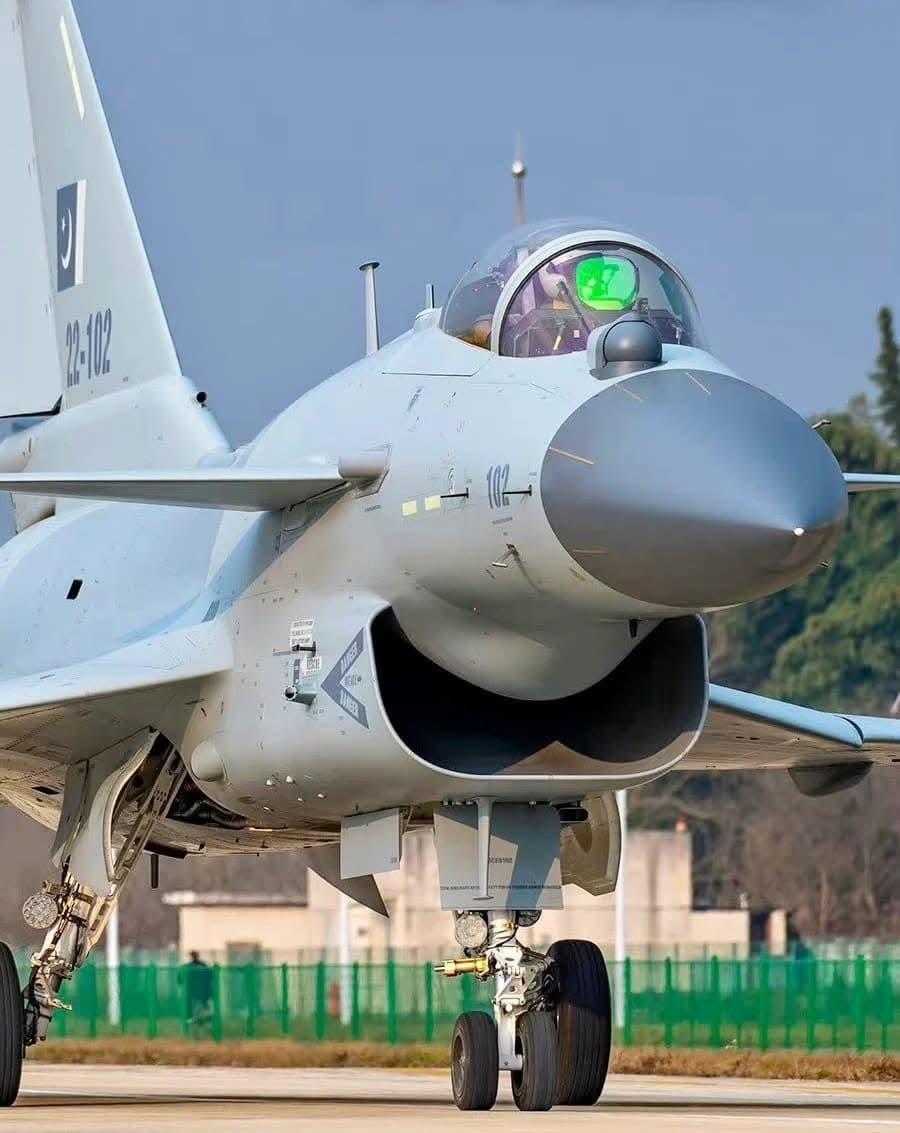
Evolving from the baseline J-10A, the J-10B and J-10C represent major generational leaps in avionics, radar systems, and propulsion, effectively positioning them as advanced 4.5-generation platforms.
While Indonesia’s J-10B purchase underscores affordability and fleet modernization, Pakistan and China’s operational use of the J-10C demonstrates the technological maturity and combat readiness of the variant.
This analysis explores in detail how both aircraft differ across design, avionics, radar, propulsion, weapon systems, and operational performance.
The J-10 series reflects China’s strategic ambition to establish an indigenous fighter ecosystem capable of rivaling Western and Russian designs across export markets.
It also highlights Beijing’s growing focus on reducing dependency on foreign propulsion systems by transitioning from Russian AL-31 engines to the fully domestic WS-10B.
Moreover, the operational deployment of the J-10C by Pakistan demonstrates not only China’s expanding influence in the South Asian security landscape but also its growing credibility as a defense exporter.
Finally, the comparative trajectory between the J-10B and J-10C illustrates China’s rapid technological maturation—bridging the gap between legacy fourth-generation fighters and stealth-oriented fifth-generation designs such as the J-20.
Background on the J-10 Series
The J-10 program originated in the 1980s as China sought to replace its aging J-7 and Q-5 fighters with a modern, high-agility multirole platform.
Work began in 1986, with the first prototype flying in 1998 and entering PLAAF service by 2004.
By 2024, over 600 J-10s had been produced, equipping both the PLAAF and the People’s Liberation Army Naval Air Force (PLANAF).
While early designs drew inspiration from Israel’s Lavi program, the J-10 evolved into a uniquely Chinese platform integrating homegrown materials, avionics, and manufacturing techniques.
The early J-10A variant featured a pulse-Doppler radar and Russian AL-31FN engines, forming the foundation for later improvements.
The introduction of the J-10B in 2008 marked a major technological leap, featuring stealth refinements and modernized sensors.
By 2018, the J-10C brought the platform into true 4.5-generation territory with an active electronically scanned array (AESA) radar and a Chinese-built WS-10 engine.
Both variants share the same aerodynamic design philosophy but differ substantially in avionics sophistication and combat capability.
The J-10B Variant
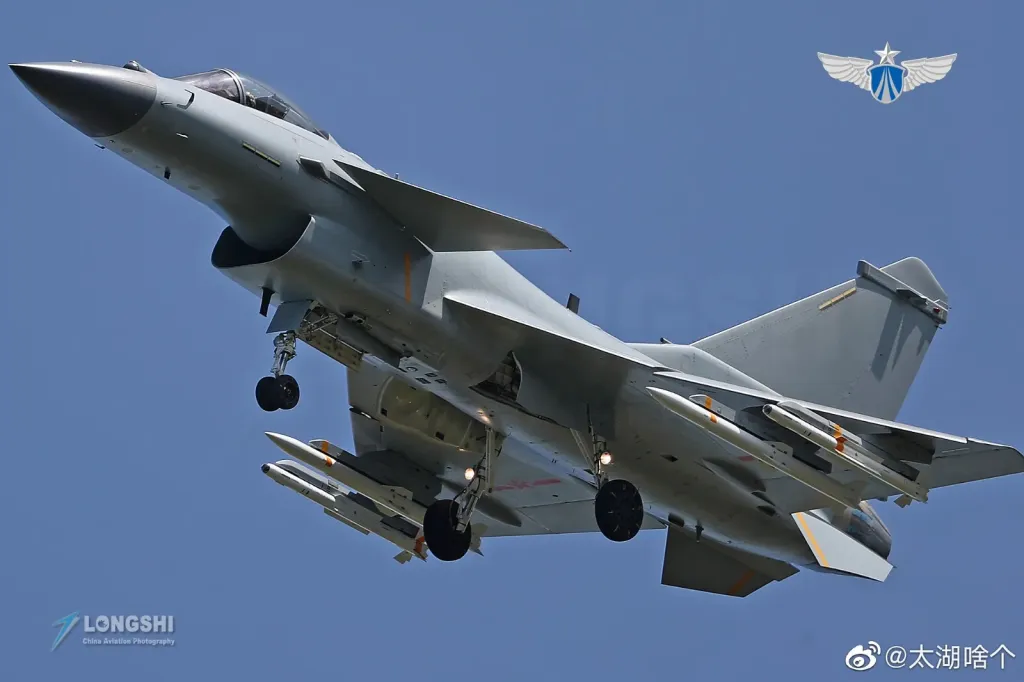
The J-10B first flew in 2008 as a limited-production transitional model bridging the J-10A and the fully modernized J-10C.
Roughly 60 aircraft were built, serving as a testbed for several next-generation technologies.
Design and Aerodynamics: The J-10B introduced a diverterless supersonic inlet (DSI), eliminating moving parts while reducing radar cross-section and improving supersonic efficiency.
Its redesigned nose radome accommodates new sensors, including an infrared search and track (IRST) system and a laser rangefinder, supported by an electronic countermeasures (ECM) pod integrated into the vertical stabilizer.
These modifications provided modest stealth advantages and improved situational awareness.
Avionics: The J-10B’s cockpit features three color multifunction displays (MFDs), a holographic head-up display (HUD), and a helmet-mounted sight (HMS), offering pilots a level of interface previously seen only in Western fighters.
It improved data fusion and introduced limited electronic warfare (EW) integration.
Radar: The aircraft is equipped with a passive electronically scanned array (PESA) radar capable of tracking 10 targets and engaging four simultaneously—an improvement over the J-10A’s pulse-Doppler system.
Engine: The J-10B uses the Russian AL-31FN M1 turbofan producing 13,500 kgf of thrust, though some prototypes tested China’s WS-10A engine.
Armament: Retaining the 23 mm GSh-23 cannon, it carries up to six tons of ordnance on 11 hardpoints, including PL-8 and PL-12 air-to-air missiles, KD-88 precision missiles, YJ-91 anti-radiation missiles, and guided bombs.
Performance: Capable of reaching Mach 1.8 and a combat radius of 1,240 km, the J-10B offered similar flight characteristics to its predecessor but better efficiency thanks to the DSI design.
Although technologically advanced for its time, production of the J-10B was brief, paving the way for the superior J-10C.
The J-10C Variant
Operational since 2018, the J-10C represents the culmination of China’s fourth-generation fighter development.
It is the most advanced and mass-produced variant of the series, integrating cutting-edge indigenous avionics, radar, and propulsion systems.
Design and Aerodynamics: The J-10C retains the DSI inlet, IRST, and ECM features but incorporates additional radar and infrared signature reductions through a redesigned engine nozzle and improved coatings.
Certain sub-variants feature a dorsal spine for extra avionics or fuel.
Avionics: The J-10C features full sensor fusion, integrating radar, IRST, and datalink data for network-centric operations.
This allows the aircraft to function as part of a larger digital battlefield, exchanging target information with AWACS and other fighters.
Radar: The shift from a PESA to an indigenous AESA radar marks the single largest upgrade.
The AESA radar provides greater detection range, superior jamming resistance, higher resolution, and enhanced tracking of stealthy or low-RCS targets such as drones and cruise missiles.
Engine: The J-10C uses the domestically built WS-10B turbofan producing 135–144 kN of thrust, providing better reliability and reduced dependency on Russian components.
Demonstrator models even incorporate thrust vectoring control (TVC) for extreme maneuverability.
Armament: The J-10C integrates next-generation missiles like the PL-10 short-range imaging infrared missile and the PL-15 long-range active radar missile with an estimated reach of 200 km.
Twin-rail pylons double the number of carried missiles, giving it a significant edge in beyond-visual-range (BVR) engagements.
Performance: With improved thrust-to-weight ratio and more efficient aerodynamics, the J-10C maintains Mach 1.8 speed but enjoys better acceleration, climb rate, and agility.
In simulated combat, J-10Cs have outperformed larger fighters such as the Su-35 due to superior radar integration and reduced radar cross-section.
Operationally, the J-10C has demonstrated real-world combat capability, reportedly achieving successful engagements in Pakistani service during 2025 confrontations.
Key Differences: A Side-by-Side Comparison
| Aspect | J-10B | J-10C |
| Introduction | First flight 2008; ~60 units | Entered service 2018; main production variant |
| Radar | PESA (tracks 10, engages 4) | AESA (superior range, jamming resistance, stealth detection) |
| Engine | Russian AL-31FN M1 (13,500 kgf) | Chinese WS-10B (135–144 kN; TVC on demonstrators) |
| Avionics | Upgraded MFDs, HUD, HMS; limited sensor fusion | Advanced sensor fusion; network-centric warfare capable |
| Stealth Features | DSI inlet, IRST, ECM pod | DSI, IRST, ECM; modified nozzle, reduced IR/RCS signatures |
| Armament | PL-8/12, KD-88, YJ-91; 6-ton payload | Adds PL-10/15; twin-rail pylons, larger BVR envelope |
| Performance | Mach 1.8; 1,240 km combat radius | Similar speed; better thrust, efficiency, and BVR dominance |
| Production | Superseded by J-10C | Ongoing; no J-10D announced |
These cumulative advancements elevate the J-10C to near fifth-generation capability, especially in electronic warfare, situational awareness, and long-range interception.
Operators and Export Context
China: Both the PLAAF and PLANAF operate the J-10 series, but the J-10C now serves as the frontline variant across multiple brigades.
Over 600 J-10s have been built, with the J-10C now representing the standard for Chinese tactical aviation.
Pakistan: The Pakistan Air Force (PAF) inducted 25 J-10CEs (export version of J-10C) in 2022 and plans further acquisitions.
Reports indicate that these aircraft have successfully conducted operational sorties and long-range engagements against Indian aircraft using PL-15 missiles.
Indonesia: Jakarta’s plan to acquire 42 refurbished J-10Bs worth up to USD 1.6 billion (RM 7.6 billion) marks its first major fighter procurement from China.
The acquisition is driven by budget constraints and the rapid availability of used airframes to bolster the TNI-AU while awaiting deliveries of Rafale and Turkish KAAN fighters.
Indonesian pilots are currently undergoing conversion training in China, with the first batch of aircraft expected soon.
While the J-10B provides Indonesia with a cost-effective upgrade in multirole capability, the J-10C remains China’s and Pakistan’s cutting-edge solution for modern air combat.
Conclusion
The evolution from the J-10B to the J-10C encapsulates China’s decade-long journey toward self-sufficiency in high-performance combat aviation.
The J-10C’s AESA radar, WS-10B engine, and long-range PL-15 missiles make it one of the most capable 4.5-generation fighters currently in service.
For nations like Indonesia, the J-10B offers a practical bridge toward modernization, providing multirole performance at a fraction of Western costs.
For Pakistan, the J-10C delivers a decisive technological edge in South Asia’s increasingly complex aerial battlefield.
Ultimately, both variants signify China’s growing aerospace confidence and its ability to export fighters that challenge Western dominance in the mid-tier combat aircraft market.
The “Vigorous Dragon” continues to evolve—not just as a fighter, but as a statement of China’s ascendance in global airpower.
The success of the J-10C underscores China’s capacity to integrate advanced radar, missile, and propulsion technologies into a cost-effective, exportable platform that appeals to emerging air forces.
Its operational use in Pakistan provides a real-world validation of Chinese aerospace engineering, enhancing Beijing’s credibility as both a supplier and strategic partner in the global defense market.
The aircraft’s growing export footprint also signals a shift in the global fighter jet balance, with China now offering credible alternatives to Western systems like the F-16, Gripen, and Rafale.
Furthermore, the J-10C’s emphasis on network-centric warfare reflects China’s broader doctrinal evolution toward integrated air combat environments supported by AEW&C and datalink assets.
As nations weigh cost, performance, and political alignment, the J-10 family demonstrates how China is redefining the competitive landscape of 21st-century military aviation.
In the years ahead, continued refinement of the J-10 platform—possibly through future variants or hybridized stealth upgrades—will determine how far the “Vigorous Dragon” can soar in China’s quest for global airpower parity.