
Why nostalgic territorial rhetoric risks undoing India–Bangladesh cooperation
A Clash of Words Across Borders
In early 2025, an unexpected war of words flared between Dhaka and Agartala. Muhammad Yunus, Bangladesh’s interim chief adviser, during a visit to Beijing, described India’s northeastern states as “landlocked” and portrayed Bangladesh as the “guardian of the ocean.” The remark was part of a broader pitch to Chinese investors, emphasizing Dhaka’s leverage as a maritime gateway to the Bay of Bengal.
The comment landed poorly in India. Assam Chief Minister Himanta Biswa Sarma quickly denounced it as “offensive.” But the fiercest reaction came from Tripura’s royal scion and leader of the Tipra Motha Party, Pradyot Kishore Manikya Debbarma. In interviews and social media posts, Debbarma called India’s 1947 acceptance of Chittagong’s transfer to East Pakistan its “biggest mistake.” He went further, urging New Delhi to support indigenous communities in Bangladesh’s Chittagong region and even “take control” of the port to break the Northeast’s dependence on the narrow Siliguri Corridor.
These remarks reverberated far beyond Tripura. Debbarma, an ally of the ruling Bharatiya Janata Party (BJP) in his state, had tapped into long-standing frustrations in the Northeast about geographic isolation. Yet his call to “reclaim” Chittagong—or even to revisit partition—strikes at the heart of a fragile bilateral relationship. It illustrates the dangerous temptation of partition nostalgia, which risks undermining decades of painstaking cooperation between India and Bangladesh.
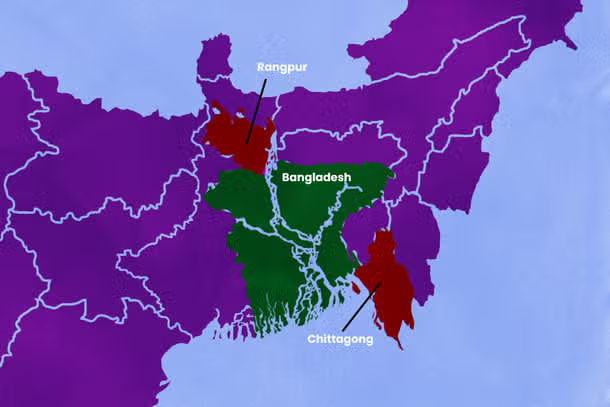
Rangpur and Chittagong live on in memory as Hindu bastions lost during the partition of Bengal — a cruel chapter for both Muslims and Hindus. The British, in their hurried designs, carried much of the blame; yet talk of “reclaiming” those places today risks inflaming old wounds and opening fresh ones, because history cannot be rewritten without paying the heavy price of renewed exclusion and resentment.
Indian Rhetoric and the Minority Card
Debbarma’s statements unfolded against a backdrop of heightened Indian rhetoric on Bangladesh. Since the fall of Sheikh Hasina’s government in August 2025, Indian media, think tanks, and security-linked outlets have amplified a familiar theme: the “diminishing rights of minorities” in Bangladesh. This narrative, long used as leverage in bilateral politics, remains New Delhi’s sharpest instrument of pressure.
For decades, India enjoyed broad access to Bangladesh’s political and minority segments, often encouraging protests or lobbying campaigns that painted Dhaka as unstable. With Hasina now in exile—ironically aided by India—the same playbook is being deployed to destabilize Bangladesh’s interim government.
The irony is glaring. India itself has faced sustained international criticism for its treatment of minorities, particularly Muslims, Christians, and Dalits. Under the BJP government, mob violence, discriminatory laws, and systemic exclusion have deepened. Yet, when Bangladesh points to these issues, Indian leaders deflect with diplomatic finesse. The double standard is hard to miss: India holds Bangladesh to account on minority rights while insulating itself from scrutiny.
Expert Voices and Official Stances
Prominent Indian figures have reinforced this harder line. Harsh Vardhan Shringla, India’s former Foreign Secretary and ex-High Commissioner to Bangladesh, warned in September 2025 against Jamaat-e-Islami’s return, calling the party a “leopard that won’t change its spots” because of its alleged role in 1971 atrocities. More tellingly, he insisted that “no issue in Bangladesh is purely internal” if it affects India’s security—a classic articulation of New Delhi’s “big brother” posture.
Meanwhile, Dr. Sreeradha Datta, a South Asia expert, described Bangladesh’s situation as a “fragile transition to stability.” In her analyses, she highlighted judicial politicization, anti-minority violence, and Dhaka’s growing closeness with China. She noted that Hindu processions in Dhaka—unprecedented in scale—reflected a new sense of vulnerability.
India’s official stance has echoed these tones. In April 2025, the Ministry of External Affairs dismissed Bangladesh’s attempt to compare violence against minorities in Dhaka and West Bengal as a “disingenuous attempt.” In February, External Affairs Minister S. Jaishankar accused Dhaka of sending “mixed signals” on bilateral relations and urged Bangladesh to stop externalizing its domestic challenges.
Such positions may be strategic, but they fuel resentment in Bangladesh. Mainstream Bangladeshis increasingly perceive India’s fixation on minority rights as hypocrisy. The outcome is a widening rift, with Dhaka seeking greater autonomy from India’s orbit.
Historical Memory and Partition’s Wounds
Debbarma’s rhetoric leaned heavily on history. He invoked the Twipra kingdom once ruled by his Manikya dynasty, whose domains extended into parts of present-day Bangladesh. He also lamented that Hindu-majority areas such as Rangpur and Chittagong were lost in the hasty 1947 partition of Bengal.
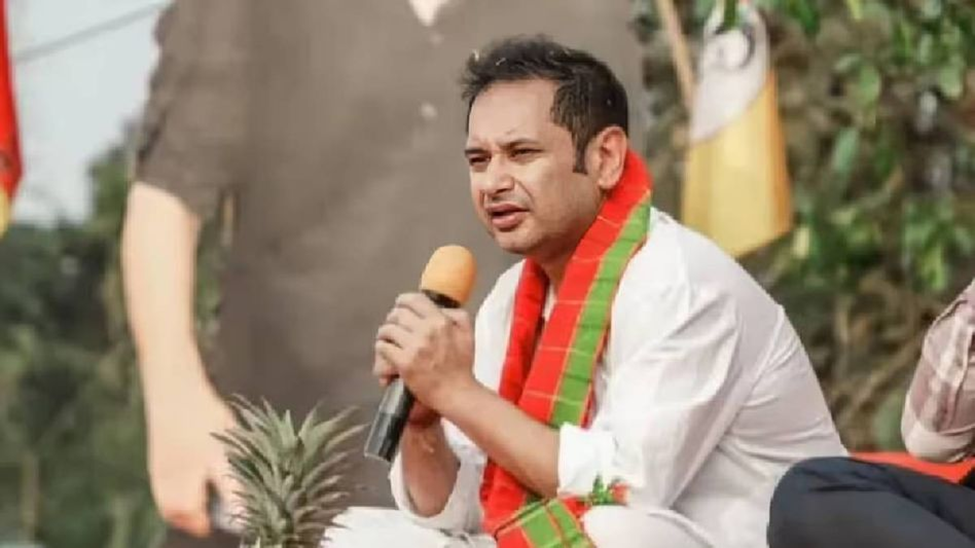
Pradyot Kishore Manikya Debbarma, the leader of the Tipra Motha Party (TMP) and an ally of the ruling BJP in Tripura
This is a powerful but perilous narrative. Partition uprooted millions, and its wounds remain raw. To suggest that borders can be revisited today risks reopening old traumas. Ordinary people—not monarchs or politicians—paid the heaviest price in 1947. To frame today’s politics in terms of “reclaiming” what was lost risks unleashing grievance-driven politics divorced from the human cost of partition.
History, moreover, is not static. While the Manikya dynasty held sway over parts of what is now Bangladesh, its authority overlapped with other kingdoms and shifting sovereignties. The modern international system recognizes Bangladesh’s sovereignty over Chattogram. Calls to redraw those boundaries are not historical corrections but provocations to chaos.
Strategic Realities of the Northeast
Debbarma’s frustrations, however, cannot be dismissed outright. India’s Northeast does face a daunting geographic predicament. Surrounded by Bhutan, Bangladesh, China, and Myanmar, the region connects to the Indian mainland only through the 22-kilometer Siliguri Corridor, often dubbed the “chicken’s neck.” This chokepoint is a logistical bottleneck and a strategic vulnerability.
For decades, policymakers have sought solutions. The 2018 transit agreements allowed India to use Bangladesh’s ports of Chattogram and Mongla for trade with its northeastern states. These routes are already cutting transport costs and delivery times, providing relief to a region long burdened by isolation. India has also invested in the Kaladan Multi-Modal Transit Transport Project, linking Mizoram to the Bay of Bengal through Myanmar.
The real answer, then, lies not in annexation but in connectivity. Ports can be accessed by agreement, not conquest. Transit can be secured through diplomacy, not partition revisionism. Debbarma’s vision of territorial reclamation ignores the practical, cooperative solutions already in motion.
Bangladesh’s Leverage and China’s Shadow
Yunus’s framing of Bangladesh as the “guardian of the ocean” was provocative, but it highlighted Dhaka’s geographic leverage. By positioning itself as a maritime gateway, Bangladesh strengthens its appeal to Chinese investors seeking Bay of Bengal access.
For New Delhi, this strikes a sensitive nerve. China’s “string of pearls” strategy—securing port access from Gwadar in Pakistan to Hambantota in Sri Lanka—already challenges India’s maritime dominance. A deeper Bangladeshi partnership with Beijing could alter the Bay of Bengal’s strategic balance.
Yet the response should not be irredentism. The real tools are port diplomacy and shared infrastructure. India has even explored operating Mongla Port through India Ports Global Limited. Such arrangements, though now stalled by political uncertainty in Dhaka, represent the kind of pragmatic engagement that builds influence without destabilizing neighbors.
Domestic Politics and Dangerous Spillovers
Debbarma’s remarks also reflect domestic calculations. As leader of the Tipra Motha Party, he has long championed the idea of “Greater Tipraland,” a homeland for the indigenous Tiprasa people extending into Bangladesh’s Chittagong Hill Tracts. His call to “support indigenous peoples” across the border aligns neatly with this vision.
Such rhetoric may mobilize local constituencies, but it carries dangerous spillovers. It provides fodder for extremist groups who thrive on territorial revisionism. It risks straining one of India’s most cooperative bilateral relationships. And it distracts from the urgent development needs of Tripura and the wider Northeast.
To its credit, the Indian government quickly distanced itself from Debbarma’s call to “break up Bangladesh.” Both ruling and opposition parties in Tripura criticized his remarks. Yet the fact that such rhetoric surfaced at all shows the enduring pull of partition nostalgia—and the need for vigilance. Once unleashed, nationalist temptations are hard to contain.
The Perils of Partition Nostalgia
Calls to “reclaim” Chittagong or Rangpur belong to a genre of politics rooted in partition nostalgia. This is the same impulse behind maps of “Akhand Bharat” or demands to redraw South Asia’s frontiers. It is emotionally potent but strategically reckless.
Borders in South Asia, however colonial in origin, are now sovereign realities recognized globally. Challenging them does not yield justice but breeds instability. Just as India resists external questioning of its own borders in Kashmir or Arunachal Pradesh, it must resist the temptation to question Bangladesh’s sovereignty over Chattogram.
For Bangladesh, hearing Indian voices muse about annexation reinforces long-standing suspicions of hegemonic designs—suspicions already stoked by policies like the Citizenship Amendment Act. For India, such rhetoric undermines its “Neighborhood First” policy and strengthens China’s narrative of India as a regional bully. For ordinary citizens, it risks ethnic polarization and fresh cycles of minority persecution.
Toward a Different Vision of Connectivity
The future lies not in redrawing borders but in reimagining connectivity. South Asia is one of the least integrated regions in the world, with intra-regional trade far below its potential. Platforms like BIMSTEC and the Bangladesh-Bhutan-India-Nepal (BBIN) initiative offer pathways to unlock prosperity through transport, energy, and digital links.
For India’s Northeast, relief will not come from annexationist fantasies but from highways, railways, and waterways that link it seamlessly with Bangladesh and Myanmar. For India’s broader strategy, counterbalancing China will not be achieved by threatening neighbors but by deepening trust and interdependence.
Partition’s wounds will heal not through reclamation but through empathy. The spirit of cooperation—built on mutual respect, not coercion—is the only sustainable path forward.
Conclusion: Choosing Diplomacy Over Destiny
The temptation to reclaim lost territories is an old one in South Asia, but it is a dangerous one. Debbarma’s call to “take control” of Chattogram reflects genuine frustrations in the Northeast, but it risks unleashing forces that neither Tripura nor New Delhi can control.
Yunus’s framing of Bangladesh as the “guardian of the ocean” may have been provocative, but it underscored a deeper truth: geography binds India and Bangladesh together. The real question is whether they treat that bond as a zero-sum rivalry or as an opportunity for shared prosperity.
India does not need to reclaim Chattogram to unlock the Northeast. What it needs to reclaim is trust—with Dhaka, with its neighbors, and with its own citizens whose futures rest on cooperation, not conquest.