
The United Nations, born from the ashes of World War II, was designed to be the cornerstone of global peace and cooperation. It was intended as a forum where conflicts could be resolved through dialogue rather than war, and where humanitarian principles would transcend narrow national interests. For much of its history, the UN has been alternately praised as indispensable and derided as ineffectual. But in 2025, as the General Assembly convenes in New York, the institution faces perhaps its gravest crisis of legitimacy and capacity since its founding.
The organization’s condition has veered from bad to worse. It suffers from severe political divisions, eroding financial support, and waning authority in conflict zones. The return of Donald Trump to the U.S. presidency has accelerated its decline. Yet despite the headwinds, the UN remains vital. It still commands tools—sanctions, peace operations, humanitarian relief—that, if used collectively and intelligently, can prevent the world from sliding into chaos. The question is whether member states have the political will to rescue the organization before it drifts into irrelevance.
The American Retreat and Its Impact
No single factor has shaped the UN’s current travails more than the shift in U.S. policy. As the organization’s largest donor, Washington has historically held disproportionate sway. Past U.S. administrations have had tense relations with the UN—from President George W. Bush’s decision to invade Iraq without Security Council approval, to Barack Obama’s selective embrace of multilateralism. But the Trump administration represents something new: not just frustration with the UN, but outright hostility.
Since January, Washington has frozen or slashed large tranches of funding across the UN system. Humanitarian agencies, which heavily depend on American contributions, have been hit the hardest. Refugee relief operations, food distribution programs, and health initiatives have all been curtailed. Beyond budgetary constraints, Trump has openly dismissed core UN principles. Respect for the sovereignty and territorial integrity of states, enshrined in the Charter, has been sidelined in favor of unilateral deals that bypass the multilateral process.
This is not merely an administrative nuisance. For the millions who depend on UN aid—whether in refugee camps in Bangladesh, famine-stricken regions of Sudan, or bombed-out neighborhoods of Gaza—Washington’s withdrawal of support translates directly into hunger, displacement, and death.
Conflict Zones Where the UN Has Been Marginalized
The weakening of the UN is most evident on the ground, in the world’s conflict zones. In Gaza, the calamity has reached historic proportions. Israel, with U.S. backing, has sidelined UN agencies, accusing them of complicity with Hamas. Humanitarian convoys have been blocked, food and medicine restricted, and international staff harassed. America, rather than supporting multilateral relief, has stepped in with its own distribution programs—programs critics describe as bait, designed to lure desperate populations into dependence while shielding Israel from accountability.
Sudan provides another bleak example. Since the civil war broke out, warring factions have prevented UN agencies from reaching those in need. Mediation attempts have been dismissed as irrelevant. In the Democratic Republic of Congo and South Sudan, rebel groups have attacked blue-helmet peacekeepers, eroding the credibility of UN missions. Security Council debates over crises in Haiti, Somalia, and Myanmar have stalled, partly due to the U.S.’s disengagement, but also because of entrenched rivalries between the permanent members.
What all these cases reveal is that the UN is being squeezed from two sides. On one hand, powerful states are increasingly willing to bypass or obstruct their mechanisms. On the other hand, non-state actors treat the UN not as neutral but as a threat, making humanitarian work perilous and diplomacy fruitless.
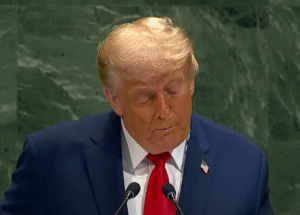 Trump addressed the UN on 23rd September.Image credit: YouTube
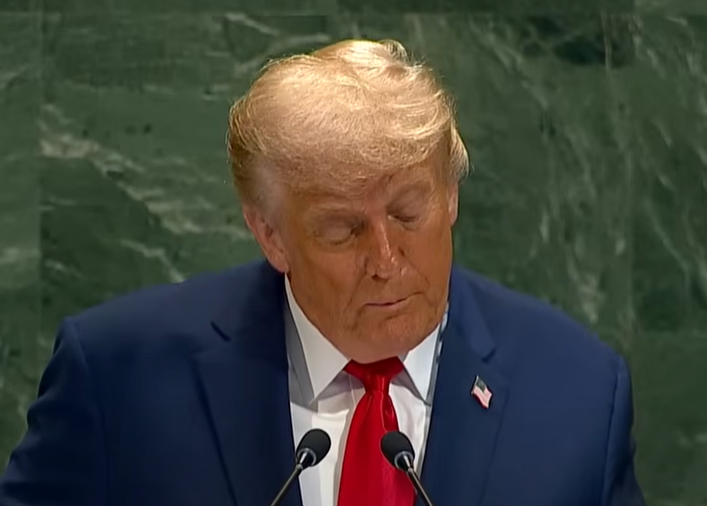
Trump’s UNGA Address: Diatribe over Diplomacy
Against this backdrop, Trump’s speech to the UN General Assembly this year was telling. Instead of presenting a vision for international cooperation, he recited a laundry list of supposed achievements—many half-baked, exaggerated, or disconnected from reality. The address was less an appeal to collective action than a scolding of the very institution he stood before.
His underlying message was clear: the UN should be a tool of American policy, not an independent arbiter. This view strips the organization of its raison d’être. If the UN becomes little more than a megaphone for U.S. priorities, other member states will have little incentive to support it. And if Washington continues to withhold funding unless the UN conforms to its line, the institution risks becoming a hollow shell.
The Tarnishing of the ICJ and Accountability Mechanisms
The International Court of Justice (ICJ), long regarded as the last bastion of civility in international law, has also been weakened. The U.S. has withdrawn from its jurisdiction, ensuring that American actions cannot be scrutinized. Meanwhile, alleged war criminals from the Middle East, including Israeli leaders implicated in Gaza, have avoided accountability. Benjamin Netanyahu and his associates continue to travel the globe with impunity, their actions shielded by the patronage of great powers.
This undermines the entire edifice of international justice. If the most powerful can ignore the ICJ with ease, why should weaker states respect its rulings? The erosion of accountability mechanisms feeds a vicious cycle of impunity, emboldening aggressors from Myanmar’s junta to militias in Africa.
Humanitarian Aid and the Substitution Game
One of the most dangerous consequences of America’s retreat has been the fragmentation of humanitarian aid. In Gaza, the U.S. replaced the UN Population Fund (UNFPA) and other agencies with its own relief programs. This duplication not only wastes resources but also politicizes the delivery of aid. In theory, humanitarianism should be impartial. In practice, it has become an instrument of statecraft.
Elsewhere, traditional UN donors have scaled back. The plight of Rohingya refugees in Bangladesh, once a major focus of international solidarity, has slipped down the agenda. In African war zones, displaced populations now rely more on regional or bilateral assistance than on UN structures. For those trapped in conflict, this means longer delays, less oversight, and greater vulnerability to exploitation.
Structural Weakness: The Burden of New York
Beyond political obstruction, the UN also suffers from structural inefficiencies. Hosting its headquarters in New York imposes enormous fixed costs, from real estate to security. These costs have risen significantly, forcing the organization to rely heavily on donor funding to maintain operations.
A bold reform would be to relocate the headquarters to a less expensive country, such as South Africa, Brazil, or even China. Such a move could significantly reduce expenses, increase the UN’s representation of the global South, and decrease its reliance on U.S. funding. Yet this is precisely why Washington would oppose it—the U.S. benefits from hosting the UN, both economically and diplomatically. The likelihood of relocation is slim, but the idea underscores the need for creative solutions to reduce dependency on any single member state.
A Way Forward: Reviving the UN’s Role
Despite these setbacks, it would be a mistake to write the UN’s obituary. Its track record is far from flawless, but it has achieved successes—from peacekeeping missions in Namibia and Cambodia to global health campaigns against polio and Ebola. The institution remains the only forum where all states, regardless of size, can engage on an equal footing.
To revive its relevance, several steps are essential:
- Diversify Funding Sources.
Member states must develop mechanisms to stabilize financing, such as assessed contributions weighted more heavily on rising economies like China, India, and Brazil. Voluntary trust funds, pooled at regional levels, could supplement core budgets. - Reform the Security Council.
Paralysis at the Council is one of the UN’s most significant liabilities. Expanding permanent membership to include major powers from the global South could reduce resentment and enhance legitimacy. More flexible voting mechanisms for humanitarian crises could prevent vetoes from stymying urgent action. - Reassert Humanitarian Neutrality.
Aid should not be an arm of politics. UN agencies must reaffirm impartiality, even when donors attempt to dictate terms. Strengthening partnerships with NGOs and regional organizations can insulate humanitarian work from great-power rivalry. - Strengthen Accountability Mechanisms.
International justice cannot be optional. Even if powerful states resist, the UN must continue to support the ICJ and the International Criminal Court. Naming and shaming violators, publishing reports, and pressing for sanctions remain tools to maintain pressure. - Prioritize Gender Equality and Human Rights.
Hard-won gains in women’s rights are under threat in conflict zones. Rolling back these standards would multiply suffering for generations. The UN must ensure that peace processes and humanitarian programs embed gender equality at their core. - Get Ahead of Emerging Crises.
Too often, the UN reacts rather than anticipates. A proactive approach is urgently needed in Syria, Afghanistan, Haiti, and Ukraine—conflicts that are likely to evolve rapidly and unpredictably. Early-warning mechanisms and preventive diplomacy must be taken seriously, not just discussed in abstract terms.
From Self-Pity to Purpose
The dominant emotion at the UN in 2025 has been self-pity. Diplomats lament shrinking budgets, political stalemates, and public criticism. Yet resignation is a luxury the world cannot afford. The crises unfolding—from Gaza to Sudan, from Haiti to Ukraine—demand more, not less, multilateral engagement.
Yes, the UN is battered. Yes, its authority is challenged. But its very weakness is also its strength: it is not a single state but a collective forum, one that—even in reduced circumstances—can still rally international legitimacy. What it needs most is political courage from its members.
The founders of the UN understood that the organization would always be constrained by geopolitics. The Security Council was designed to give the great powers vetoes, not out of idealism, but out of realism. Yet despite those constraints, the UN has, time and again, played an indispensable role in mitigating crises. The task today is not fundamentally different—except that the stakes are higher, the conflicts bloodier, and the international order more fragile.
The United Nations stands at a crossroads. It can slide further into irrelevance, a relic of a bygone era of multilateralism. Or it can reclaim its purpose, imperfectly but urgently, in a world where the need for collective solutions has never been greater.
The choice lies not in the Secretariat, nor even in New York, but in the capitals of member states. Do they still believe in multilateralism? If so, the UN can be renewed. If not, the world risks a descent into a lawless order where might makes right.
The crises in Gaza, Sudan, Haiti, and Ukraine will not wait. Nor should the UN.